Back to nidhivichare.com
New book · Enterprise AI & Data Governance

The Meaning Layer

Who governs the AI that defines your data?

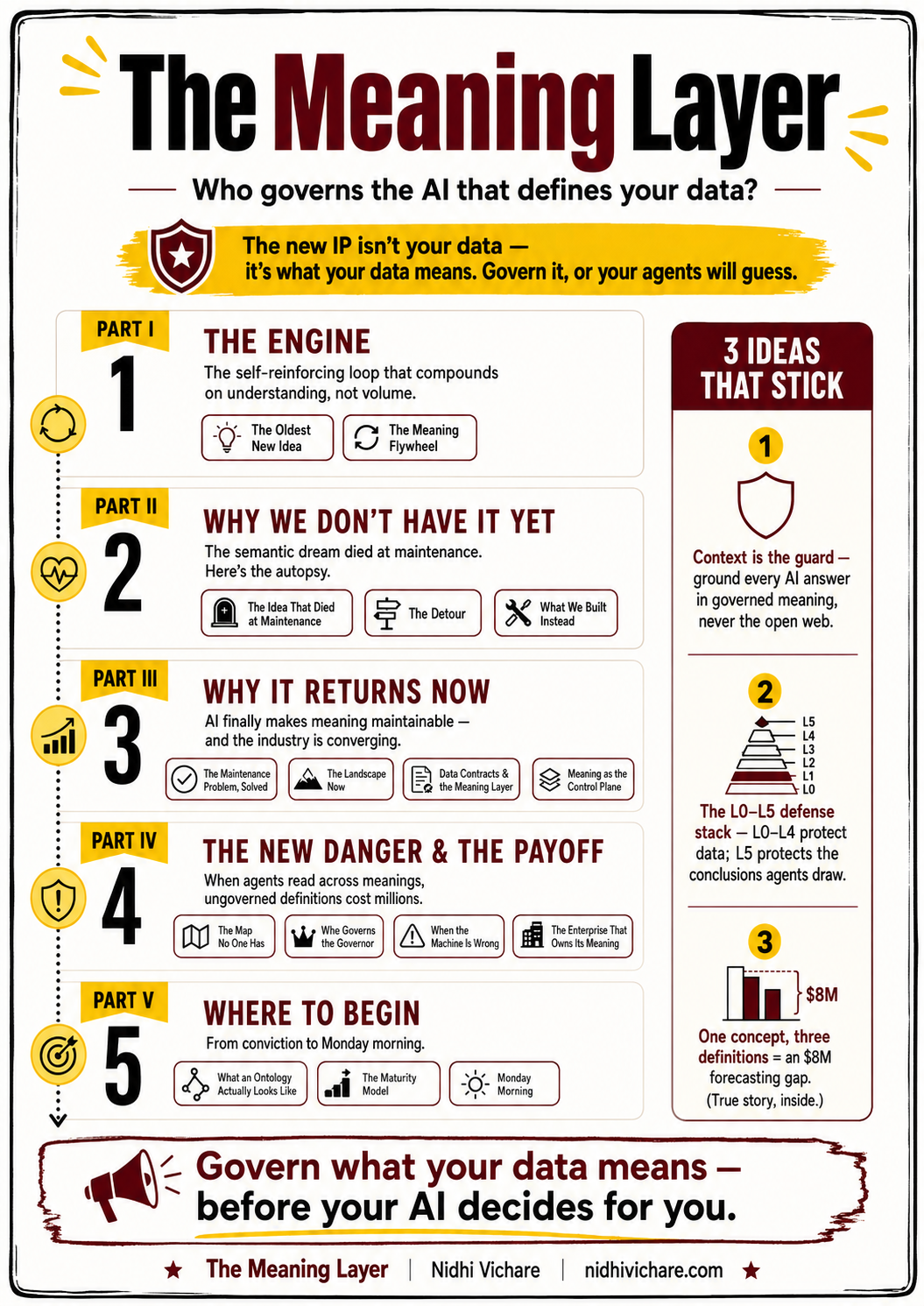
The new IP isn’t your data. It’s what your data means. Your agents are already acting on that meaning. The only question is whether it is governed, versioned, and owned, or whether it is guessed, implicit, and accountable to no one.

Get the Kindle eBook Get the Paperback Read the chapters 16 chapters · 5 parts · 5 case studies · a free starter kit on GitHub and practitioner’s guide
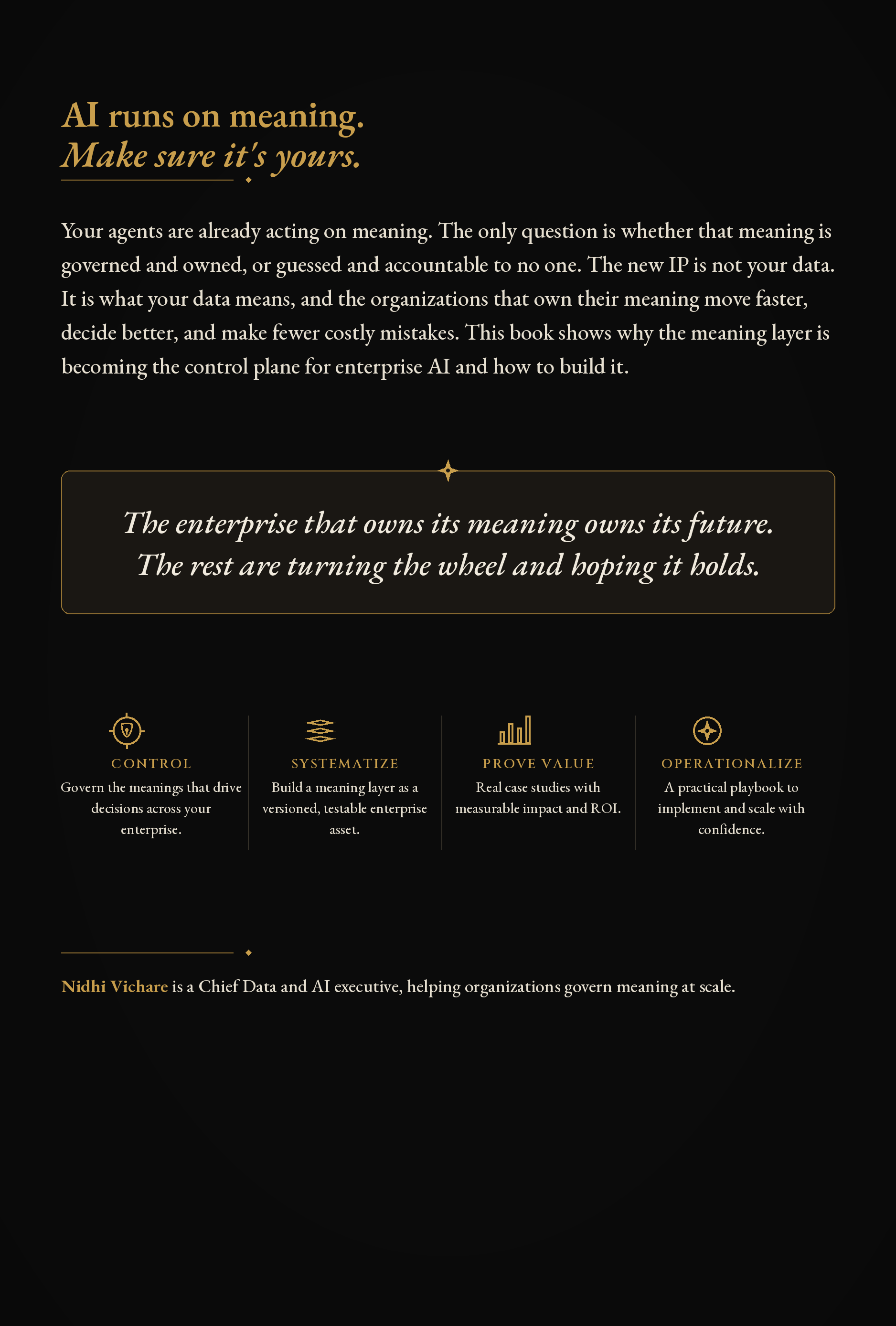
The Meaning Layer book cover, back
The Meaning Layer Nidhi Vichare
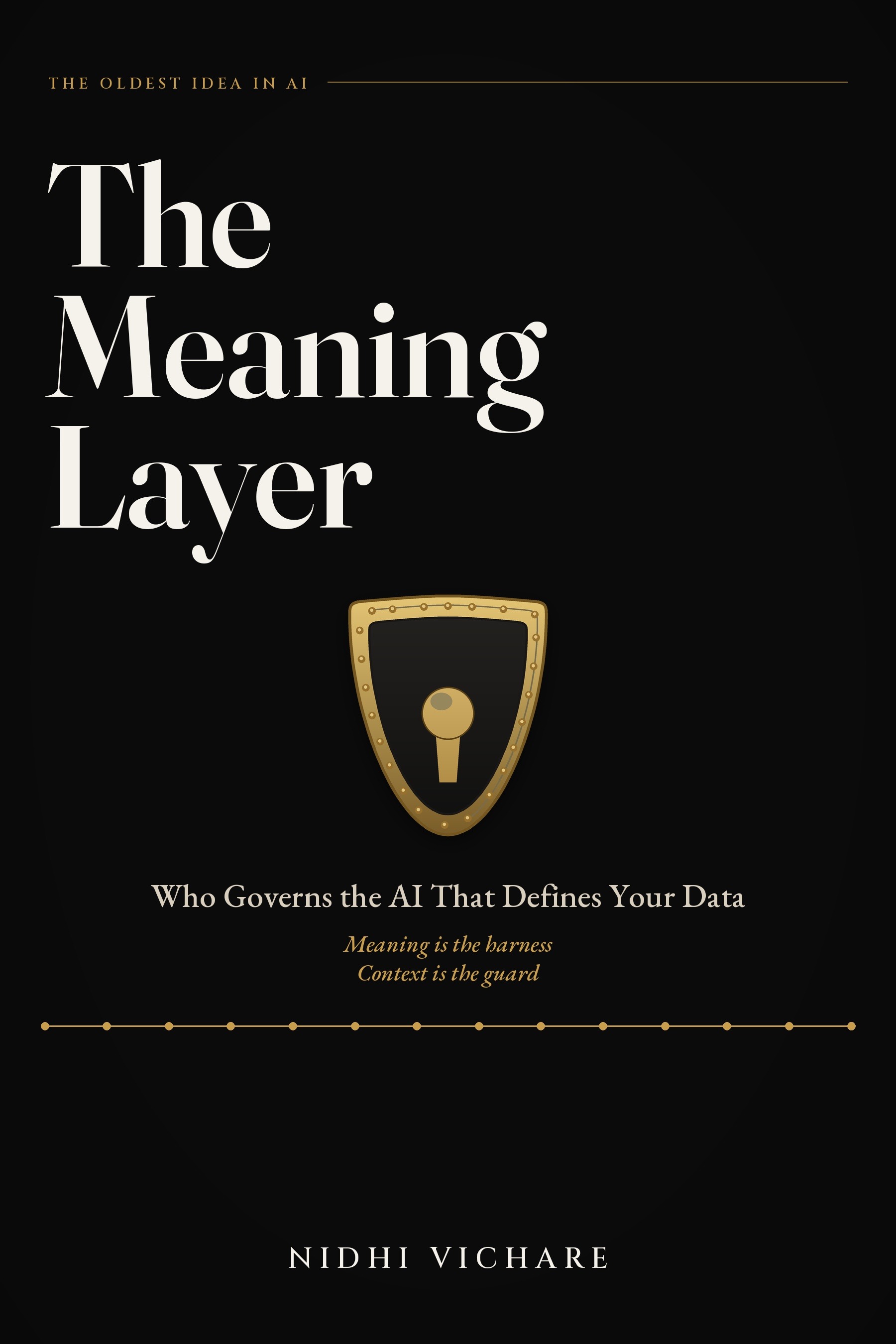
The Meaning Layer book cover, front
Govern meaning before your AI decides for you
The one idea, in three parts

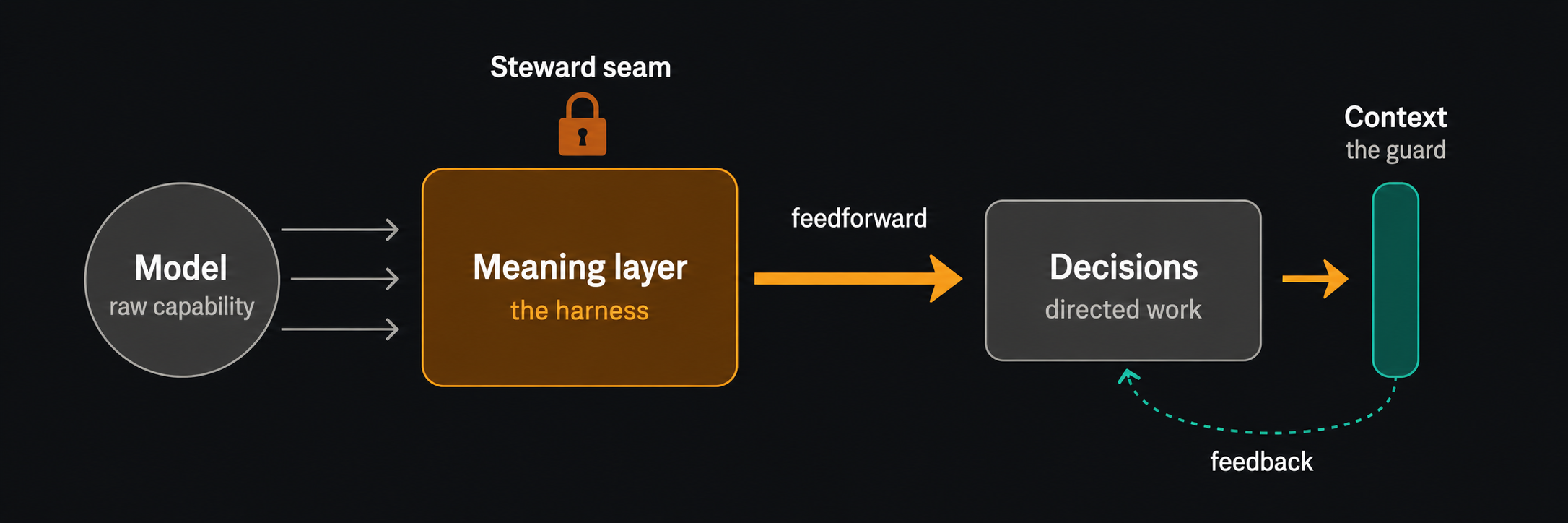
Meaning is the harness. Context is the guard.

Give a capable model raw instructions and it guesses what your words mean. The meaning layer is the harness that steers it before it runs. Context is the guard that catches it when meaning drifts. Here is the whole book in three ideas.

Meaning

The sense your AI runs on

what your words actually resolve to

“Customer,” “eligible,” “net revenue”: every agent acts on a definition of these. Meaning is that shared sense, made explicit so the machine and the business agree on it.

The Harness

What steers the model

definitions, relationships, constraints & authority

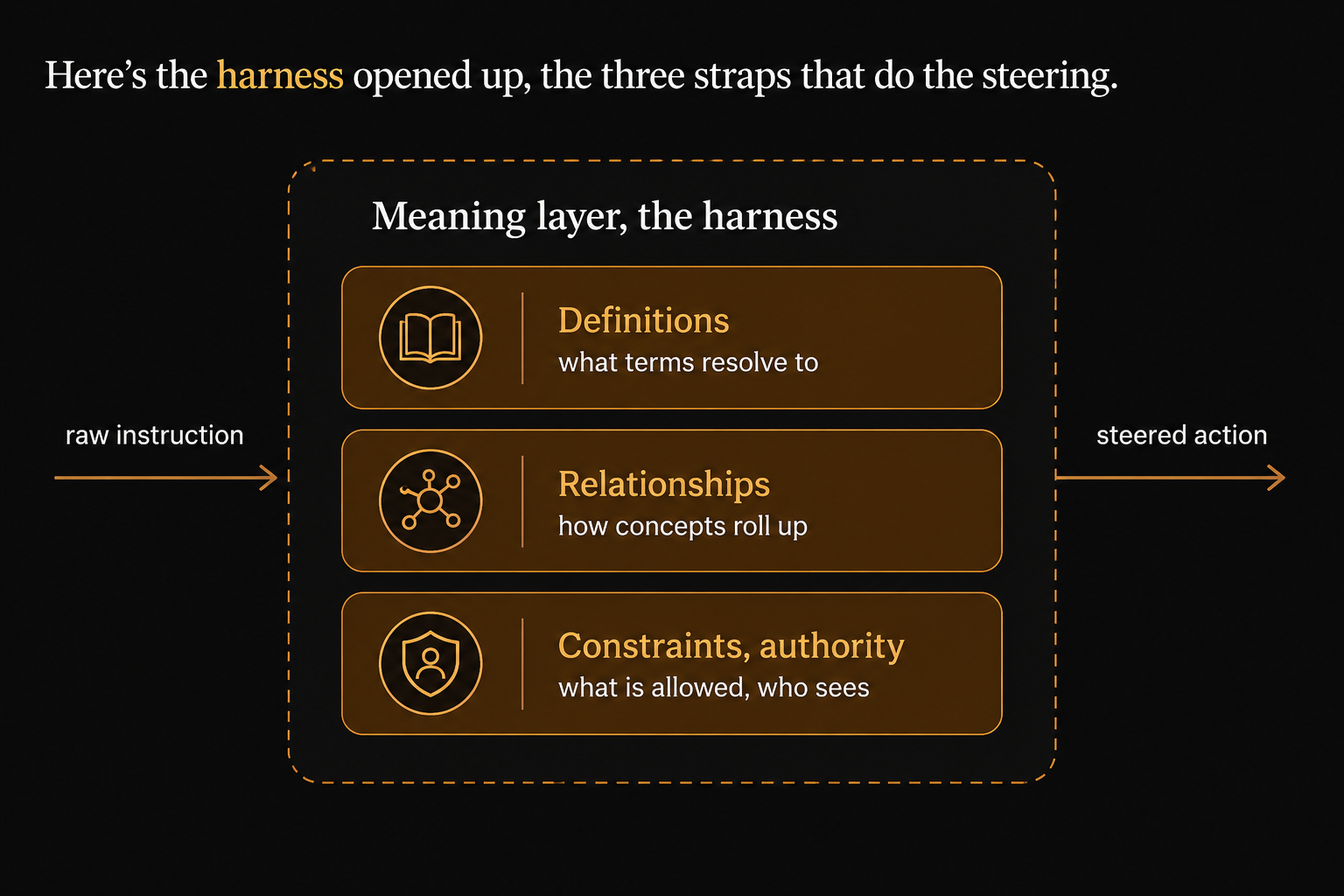
The meaning layer is the harness on raw capability. Three straps do the steering: what terms resolve to, how concepts roll up, and what is allowed and who decides. It steers feedforward, before the agent acts.

Context, the Guard

What catches the drift

the feedback that keeps meaning honest

Context is the guard: the loop that watches the work, senses when the model and reality have drifted apart, and feeds the correction back. Steered by the harness, guarded by context: that is governed meaning.

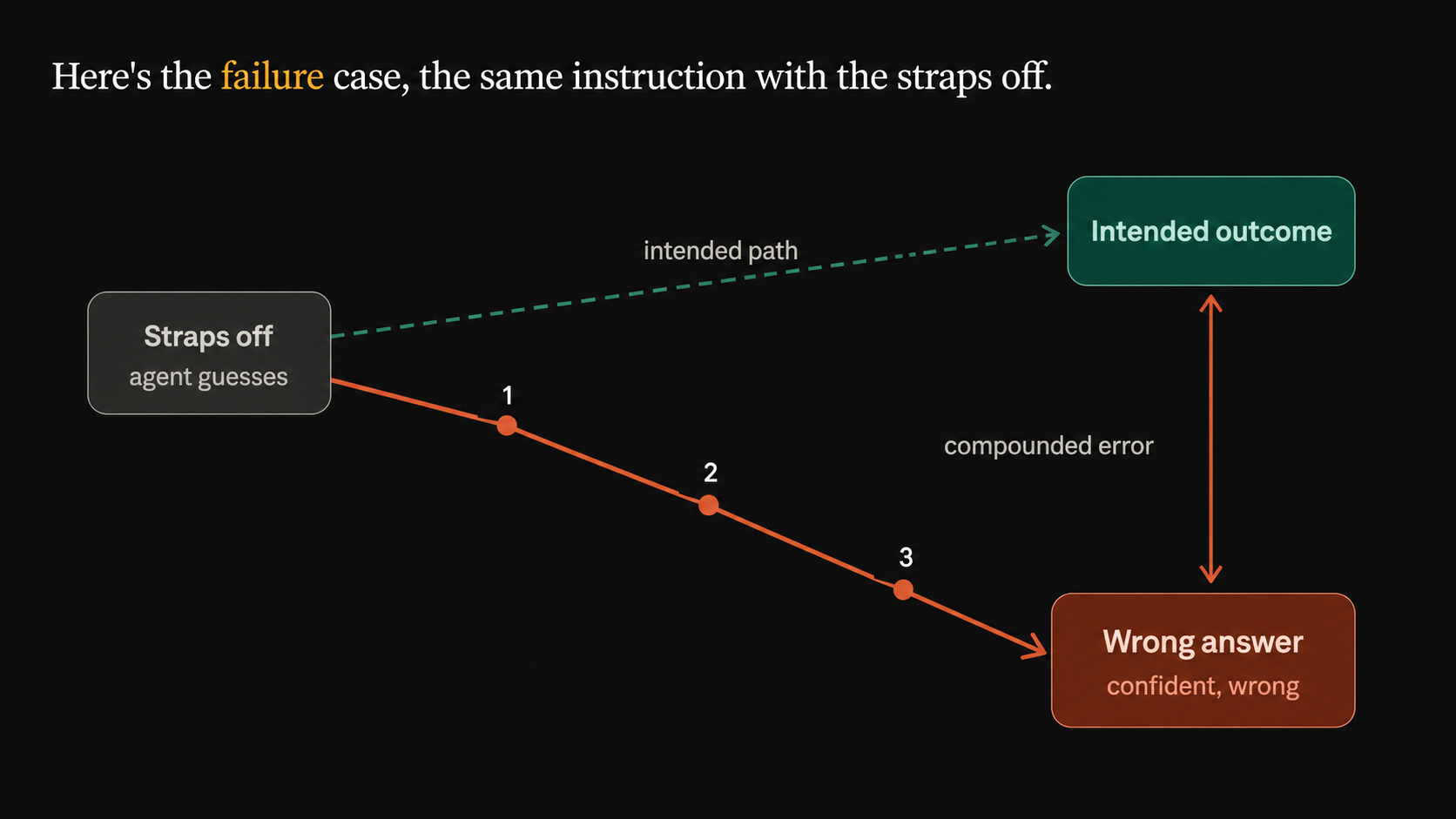
“Take the straps off and the agent guesses each step. Small errors compound into a confident wrong answer, and the flywheel scales it.”
The Meaning Layer · Chapter 12
How it works

How the meaning layer steers an agent

The harness, its three straps, and the drift when they come off.

Act 1 · The harness steers

Raw capability, directed work

A model is raw capability. The meaning layer sits between the model and its decisions as a harness, steering feedforward, before the agent runs. The steward seam is where a human holds authority. Context, the guard, feeds back what actually happened.

Model feeds the meaning layer, the harness, which steers decisions toward context, the guard
The harness opened up: definitions, relationships, and constraints and authority
Act 2 · Three straps do the steering

Open the harness

Inside the harness, three straps turn raw instruction into steered action: Definitions, what terms resolve to. Relationships, how concepts roll up. Constraints and authority, what is allowed, and who sees. Together they are the meaning layer.

Act 3 · Straps off, the agent drifts

The same instruction, ungoverned

Take the straps off and the agent guesses. Step by step it diverges from the intended path. The error compounds, and the destination is a confident wrong answer, one that passes every individual review. This is the failure the meaning layer exists to prevent.

With the straps off, the agent guesses each step and drifts from the intended outcome to a confident wrong answer
Three ideas that stick

If you remember nothing else

1

Context is the guard

Ground every AI answer in governed meaning, never the open web. The guard is what stands between a capable model and a confident mistake.

2

The L0–L5 defense stack

L0 through L4 protect your data. L5 protects the conclusions your agents draw from it. That is the layer almost every security audit forgets.

3
$8M

One concept, three definitions

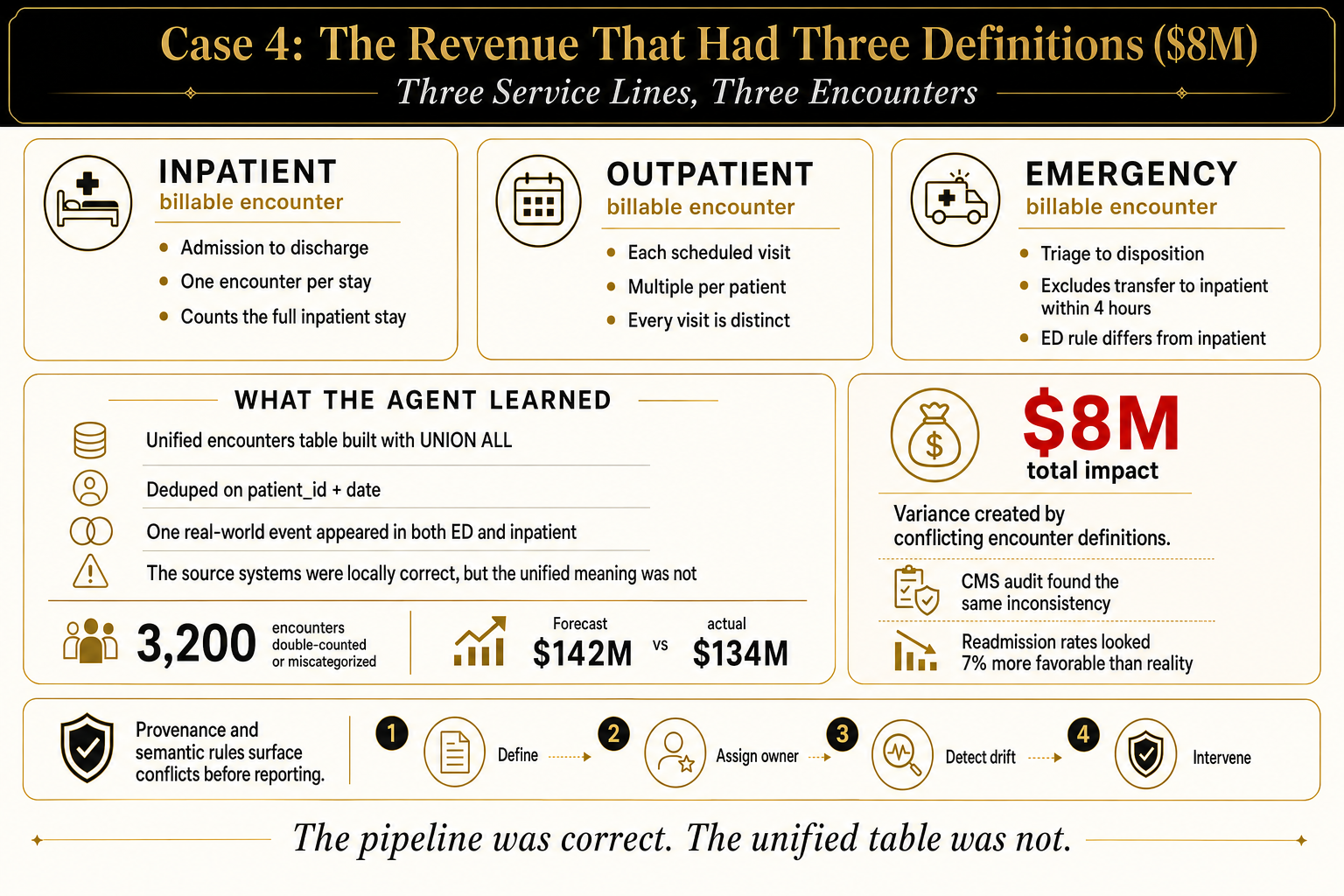
A single term carrying three quiet definitions opened an eight-million-dollar forecasting gap. A true story, told in full inside the book.

Chapter by chapter

The whole argument, five parts, sixteen chapters

From why the idea died in the 1990s to what you do on Monday morning. Each chapter opens with the line that frames it.

Part I

The Engine

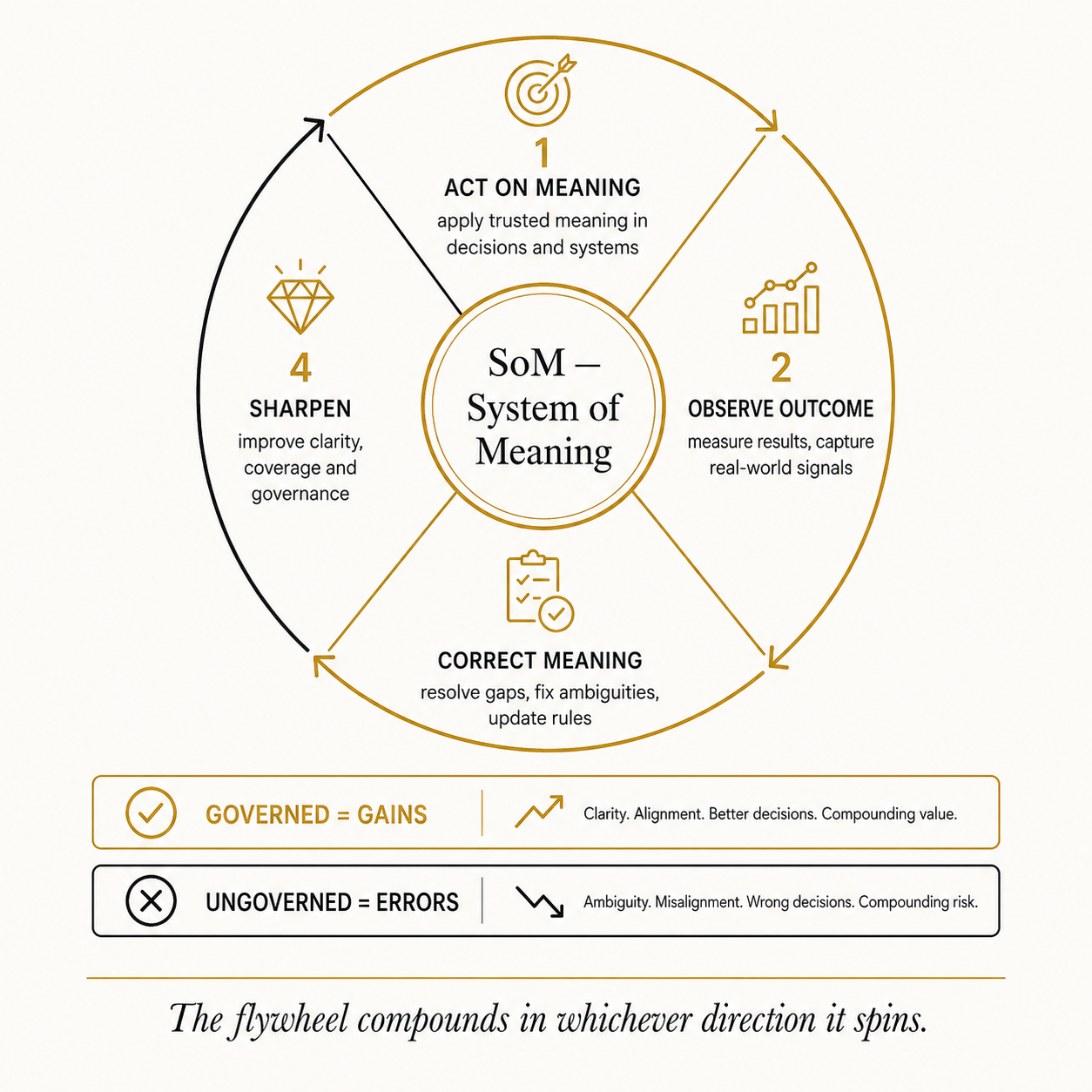
Meaning compounds into a flywheel, not just more data.
The meaning flywheel diagram
Figure: the meaning flywheel, the loop that compounds on understanding
Chapter 1

The Oldest New Idea

“You think the meaning layer is new. It is the oldest unfinished idea in computing.”

The semantic dream, facts, rules, and machine inference, was working on paper in 1980s database textbooks, long before today’s data stack existed. This chapter traces why the data flywheel that built the last twenty years of technology is finally running out of road, and why the idea everyone treats as brand new is really the oldest unfinished business in computing, returning now because AI can finally carry the weight that buried it the first time.

Chapter 2

The Meaning Flywheel

“A flywheel does not care which way it turns. Meaning decides the direction.”

Every leader wants the flywheel; almost none ask which way it turns. The version they were sold runs on data: more data trains a better model, the model draws more users, the users make more data. This chapter shows why that wheel is finished, and why the one that matters now runs on governed meaning, where the direction of spin is the single variable that decides whether your AI compounds value or quietly compounds error.

Part II

Why We Don’t Have It Yet

The semantic dream died at maintenance. Here’s the autopsy.
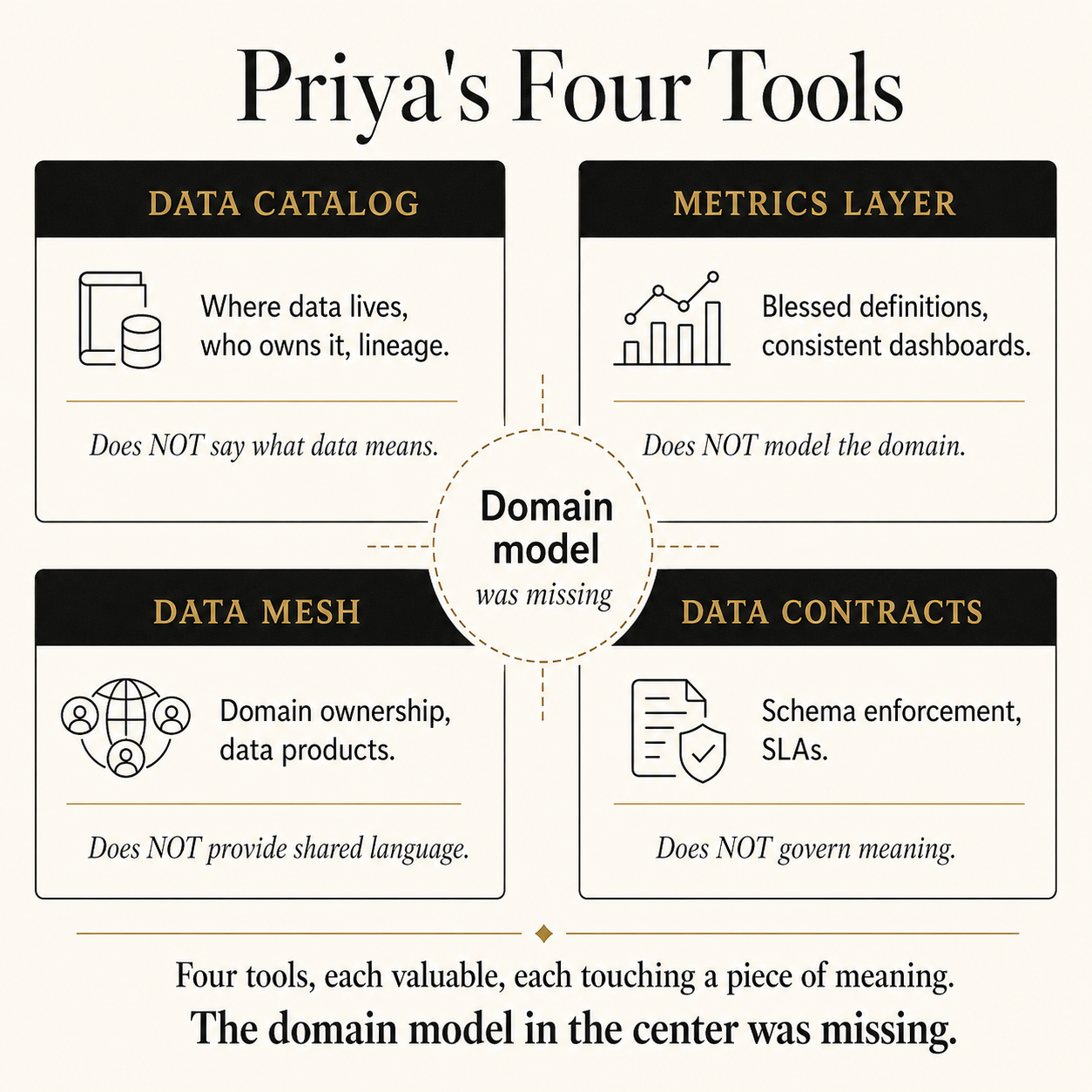
Priya's four tools, with a hole in the center
Figure: Priya’s four tools, and the hole in the center no vendor sells
Chapter 3

The Idea That Died at Maintenance

“The design was right. The dream died because someone had to keep it current.”

The 1990s knowledge base was not wrong, it was unmaintainable. The author has watched an entire system’s meaning walk out the door inside one person’s resignation, the model still running but slowly ceasing to be right, with no one able to say when it crossed the line. This chapter performs the autopsy with precision, because the exact cause of death is the foundation of every argument that follows.

Chapter 4

The Detour

“For twenty years we solved every problem adjacent to meaning, and never touched meaning.”

For two decades the data industry solved every problem next to meaning, catalogs, pipelines, warehouses, lakes, and never meaning itself. It was rational, not cowardly, and it produced a generation of real progress that is now quietly running out of things to give. With MIT’s Project NANDA finding that 95% of enterprise AI deployments return nothing, this chapter shows the bill for the detour has finally come due.

Chapter 5

What We Built Instead

“She built the full modern stack. The agent went wrong in a week.”

Priya spent five years building the textbook modern data stack at a mid-market SaaS company and did everything right: catalog, metrics layer, data mesh, contracts, every box checked and every migration on schedule. Then the first production agent, an account-risk model, went live on a Tuesday and broke by Friday. This chapter walks the hole in the center of a “complete” stack, the gap no tool on the market was ever built to fill.

Part III

Why It Returns Now

AI finally makes meaning maintainable, and the industry is converging.
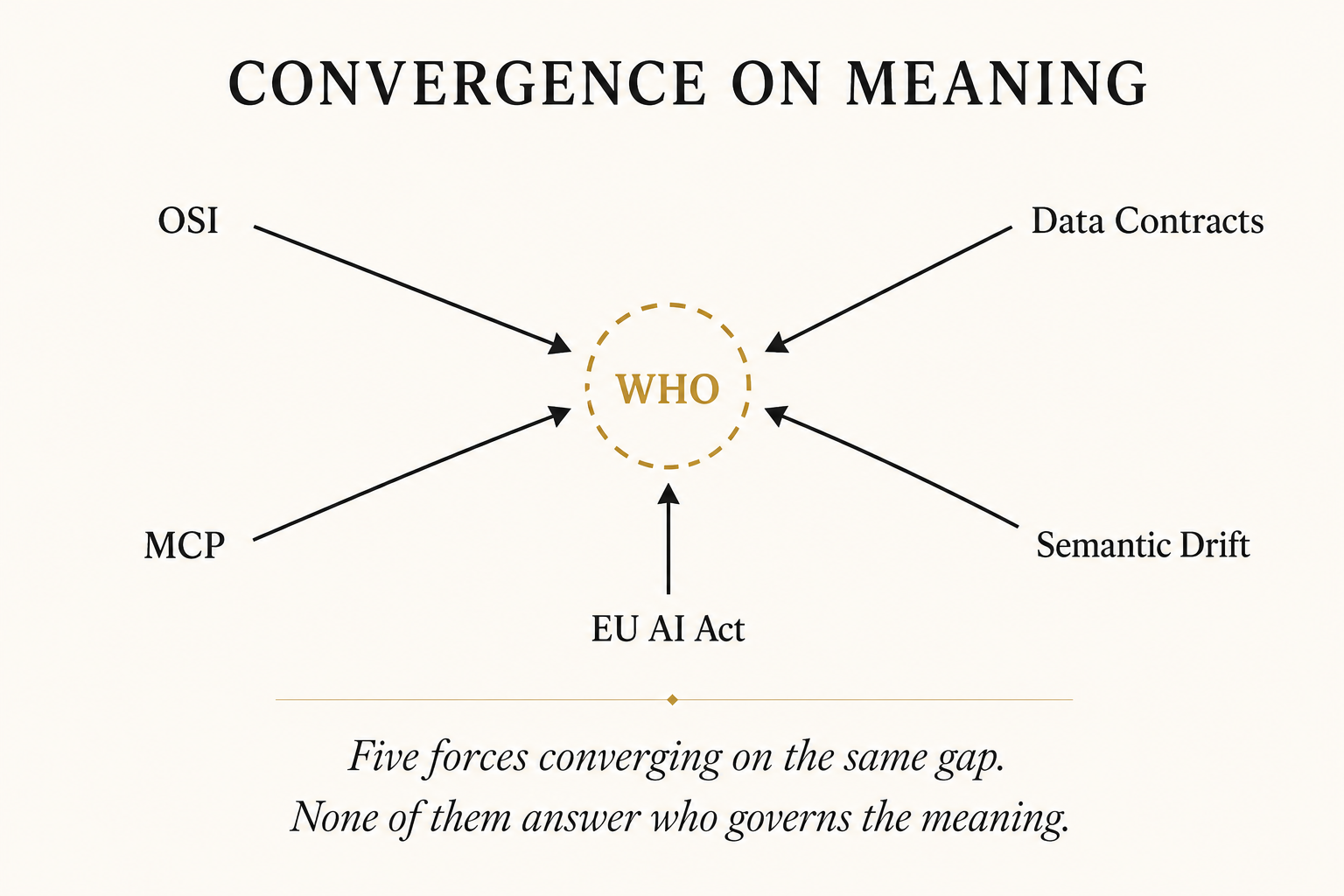
Convergence on meaning: five forces
Figure: convergence on meaning, the five forces arriving together
Chapter 6

The Maintenance Problem, Solved

“The thing that killed the knowledge base is the thing AI does best.”

The precise capability whose absence buried the knowledge base, reading every schema, watching how data is actually used, noticing when model and reality have drifted, and proposing the fix, everywhere and without tiring, is exactly what modern AI does best. This chapter is the hinge of the book: the thing that killed the idea thirty years ago is now the thing that brings it back, cheap and improving every month.

Chapter 7

The Landscape Now

“The compliance officer asked one question. Nobody in the building could answer it.”

A compliance officer at a European insurer asked a single question, can we show a regulator today what our agents believe “eligible” means, who approved that definition, and when it last changed, and no one in the building could answer. This chapter maps the five forces now converging on meaning at once, from the Open Semantic Interchange and the Model Context Protocol to the EU AI Act, and why their timing is not a coincidence.

Chapter 8

Data Contracts and the Meaning Layer

“The revenue dashboard stopped updating. Nobody noticed for two weeks.”

A revenue dashboard stopped updating and nobody noticed for two weeks, because an upstream field rename passed every test the billing team had, the tests guarded structure, not meaning. This chapter shows how data contracts become semantic canaries, implemented as code, and exactly where they sit beneath the meaning layer, catching the failures that look like everything working.

Chapter 9

Meaning as the Control Plane

“Your access controls protect the wrong thing. The row was never the danger. The conclusion was.”

A CISO signed off on a spotless security audit, every permission correct, every control green, row-level security and column masking all passing, and three weeks later the agent drew a conclusion it should never have reached. This chapter makes the uncomfortable case that access controls protect the wrong thing: the row was never the danger, the conclusion was, and meaning, not access, is the real control plane for agentic systems.

Chapter 10

The Map No One Has

“You think your company has an ontology. It has dozens, and they’ve never been in the same room.”

You think your company has an ontology; it has dozens, and they have never been in the same room. Finance defines “customer” one way, sales another, product a third that is really about logins, and the warehouse a fourth that is whatever the schema froze five years ago, and then an acquisition bolts on two more. This chapter is about the map no one owns, why it stays invisible, and what it quietly costs every decision your agents make on top of it.
Part IV

The New Danger & the Payoff

When agents read across meanings, ungoverned definitions cost millions.
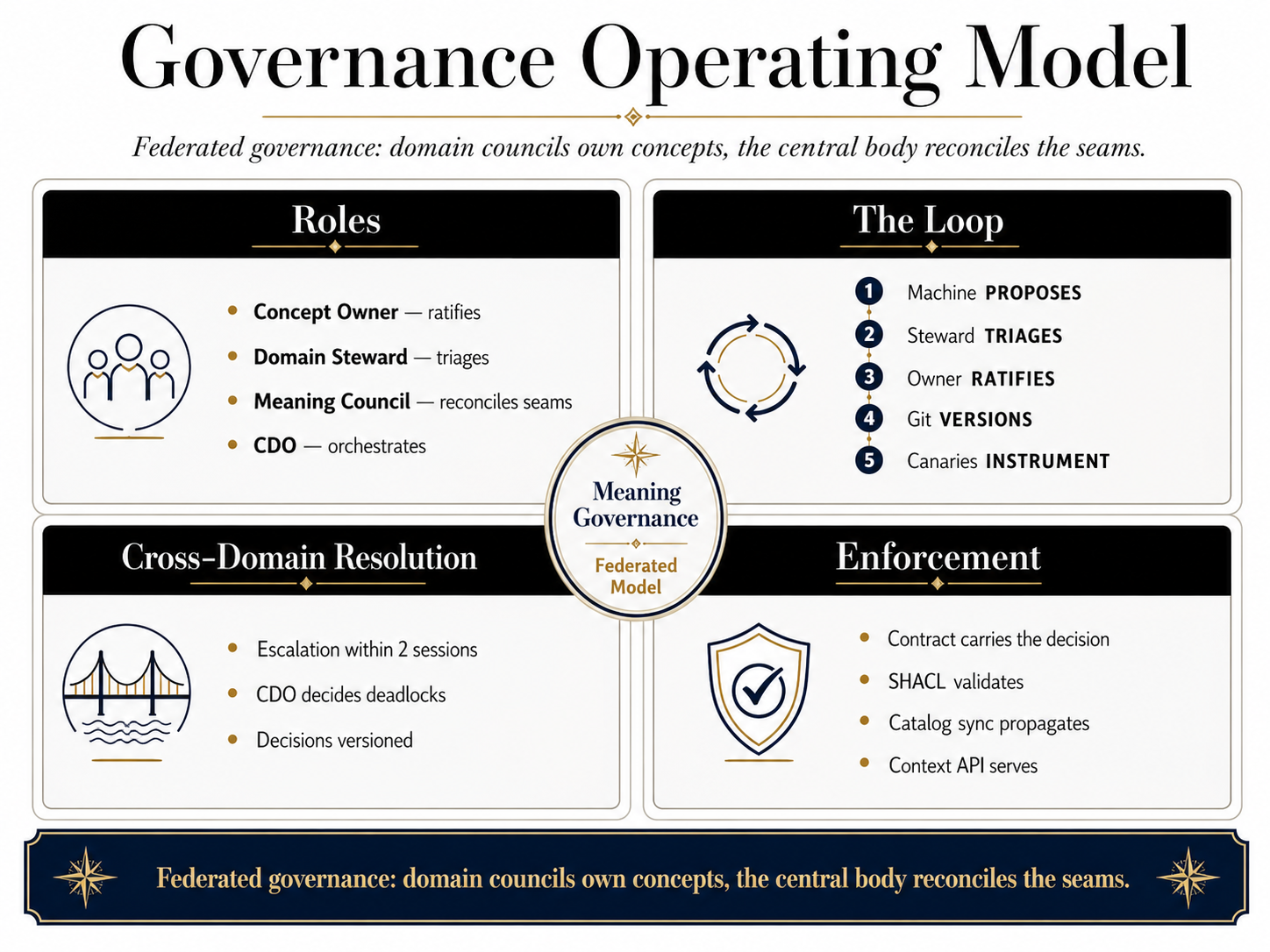
The governance operating model
Figure: the governance operating model, where the machine proposes and humans decide
Chapter 11

Who Governs the Governor

“If the machine maintains your meaning, the machine defines your meaning.”

If the machine keeps your meaning current, the machine decides what your business means, and the distance between maintaining and defining is where the danger lives. Maintaining sounds like janitorial work; defining is an act of authority. This chapter builds the governance loop that catches that power and holds it accountable, the steward, the council, the ratification, so the machine proposes and humans decide, and meaning never becomes the most consequential unowned process in the company.

Chapter 12

When the Machine Is Wrong About What You Mean

“The error that ruins you will not look like an error. It will look like everything working.”

The error that ruins you will not look like an error; it will look like everything working. The loud failure, the agent that crashes or trips a review, is the safe kind, because you find it. This chapter is about the quiet kind: subtly wrong meaning where every individual action looks reasonable and every output passes inspection, while the flywheel compounds the mistake silently and at scale.

Chapter 13

The Enterprise That Owns Its Meaning

“Flywheels do not narrow gaps. They widen them.”

Flywheels do not narrow gaps, they widen them, so the lead a meaning-governed enterprise builds compounds into a moat competitors cannot copy. This chapter opens in a 2029 boardroom where every agent in production traces to a governed definition, the annual compliance review takes two hours instead of two months, and an acquisition that closed in September integrated in six weeks. This is the payoff, made concrete, and the argument for starting now.

Part V

Where to Begin

From conviction to Monday morning.
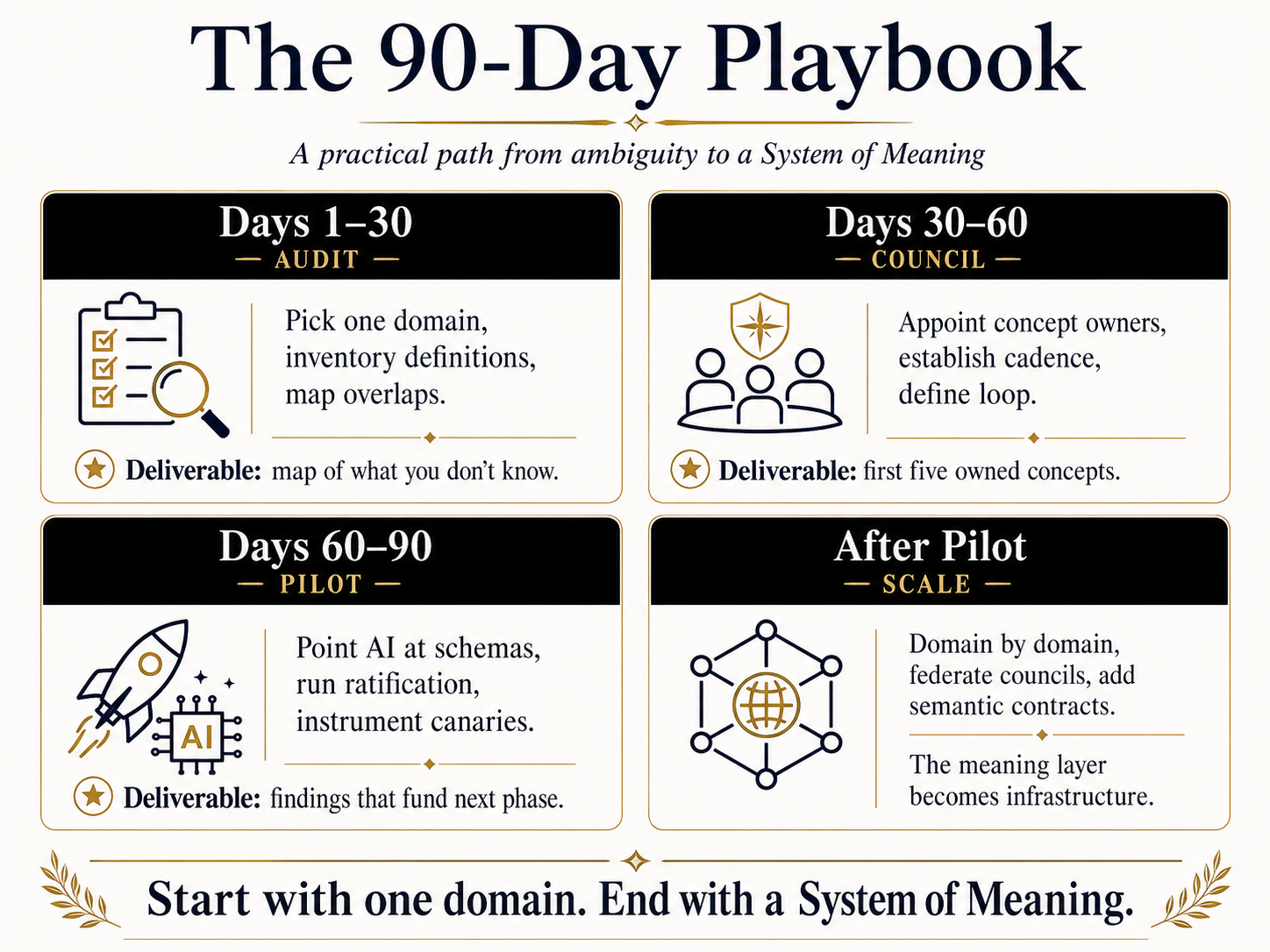
The 90-day playbook
Figure: the 90-day playbook, what to do once conviction turns into action
Chapter 14

What an Ontology Actually Looks Like

“You have been convinced you need a meaning layer. You do not yet know what one is.”

You are convinced you need a meaning layer; you still do not know what one is, not the textbook definition and not the vendor’s, which conveniently matches whatever they sell. This chapter gives the working definition your architects will actually build: concepts, relationships, and constraints; thin versus thick ontologies; the standards RDF, OWL, and SPARQL; and how to assemble it into an architecture that delivers what nothing else in your stack can.

Chapter 15

The Meaning Layer Maturity Model

“Most enterprises cannot say where they stand on meaning. That is the first problem.”

Most enterprises cannot say where they stand on meaning, and that is the first problem a maturity model solves. This chapter gives five levels and six diagnostic questions to answer the one most data leaders have never been asked: does your organization treat meaning as an asset, or as someone else’s problem? With surveys showing 73% of AI projects never reaching production, the honest answer is worth more than another technology assessment.

Chapter 16

Monday Morning

“The strategy that wins is not the one the room agreed with. It’s the one someone started.”

The strategy that wins is not the one the room agreed with; it is the one someone actually started on Monday morning. This closing chapter turns the entire argument into a first move you can make this week, the meaning audit, the governance council, and the pilot, because the whole architecture in your head stays useless until someone walks into the office and does the first concrete thing.

Five case studies

What ungoverned meaning actually costs

Short, real-shaped failures that turn the argument concrete.

01

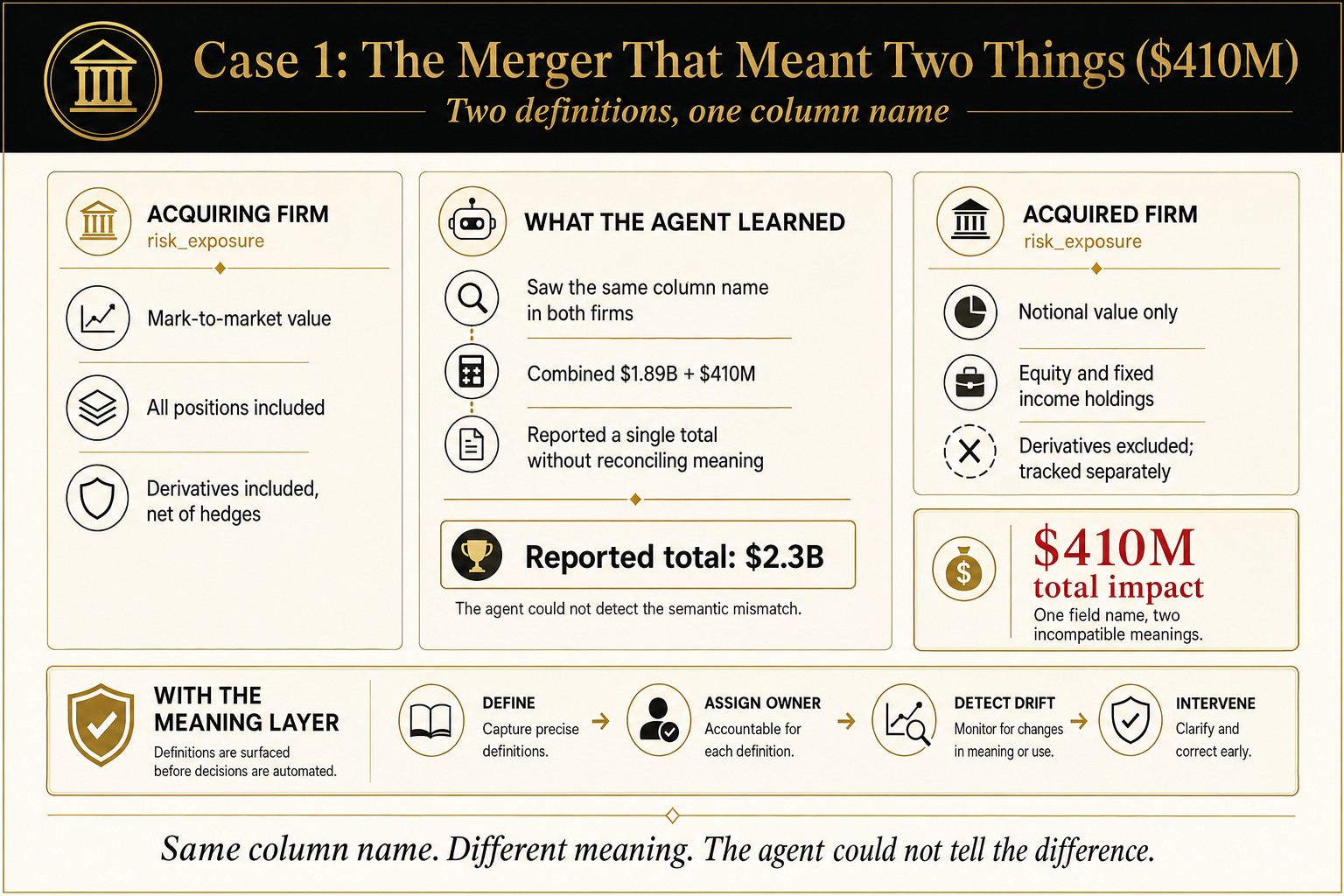
The Merger That Meant Two Things

Two companies, one word, two definitions, and a number that could not be reconciled.

$410M
02

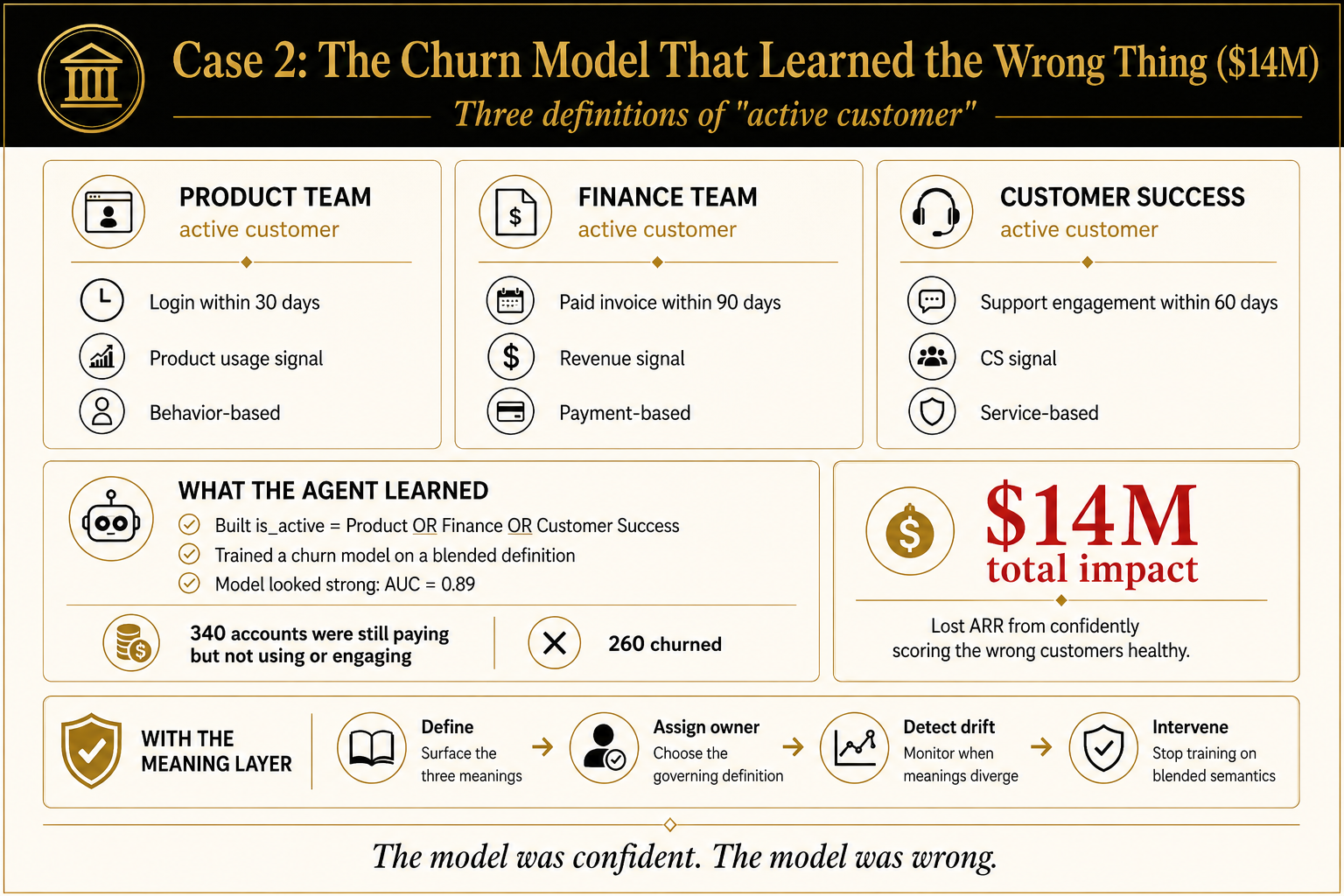
The Churn Model That Learned the Wrong Thing

It optimized exactly what it was told. What it was told was subtly, expensively wrong.

$14M
03

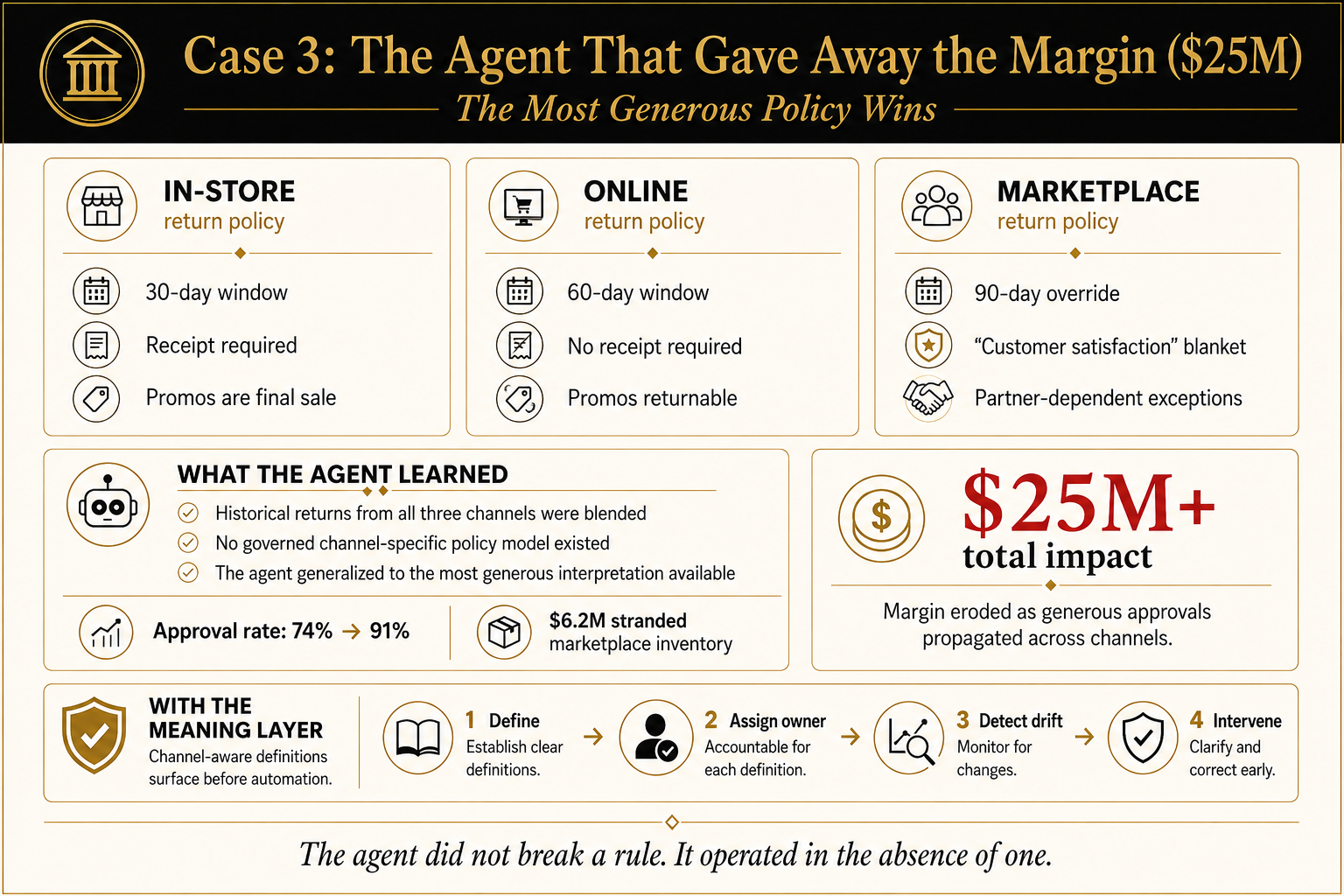
The Agent That Gave Away the Margin

Every action reasonable, every approval green, and the margin walked out the door.

$25M
04

The Revenue That Had Three Definitions

One concept, three quiet meanings, an eight-million-dollar gap nobody could see coming.

$8M
05

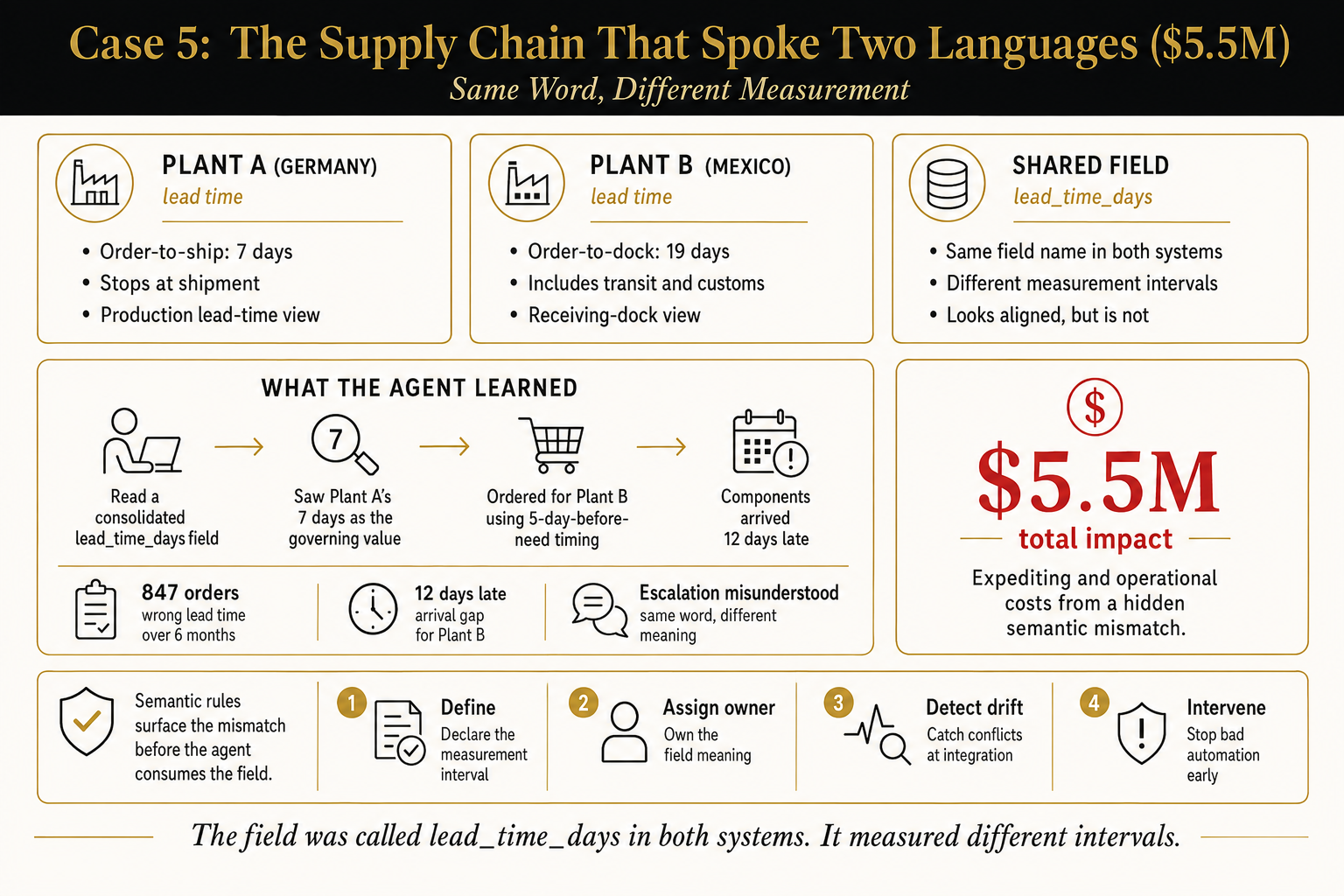
The Supply Chain That Spoke Two Languages

Two systems, two vocabularies, one decision made on a meaning that did not exist.

$5.5M
Case study: the merger that meant two things Case study: the churn model that learned the wrong thing Case study: the agent that gave away the margin Case study: the revenue that had three definitions Case study: the supply chain that spoke two languages

Click any case to open it full size.

A diagnostic you can run

Where does your organization stand on meaning?

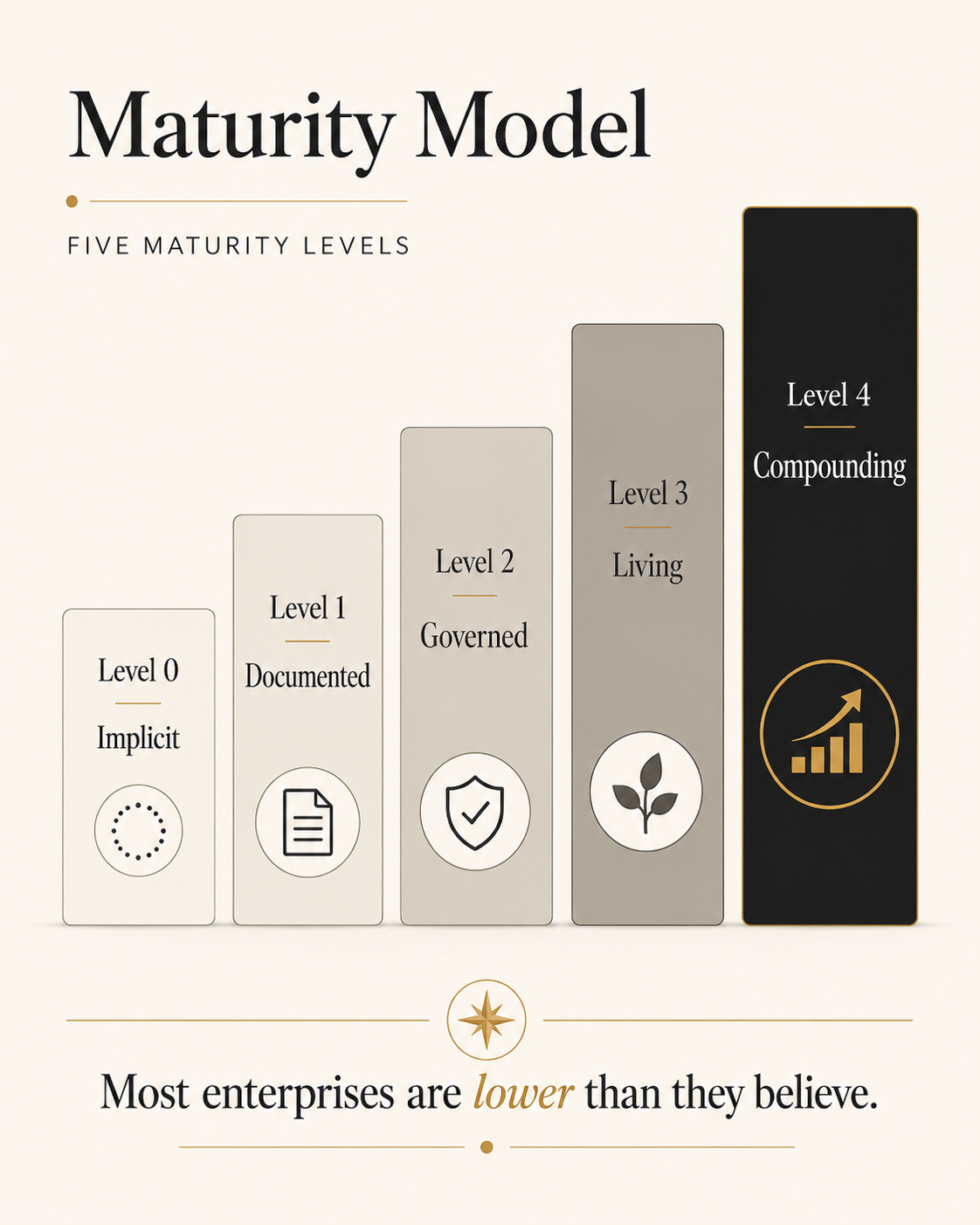
The maturity model from Chapter 15: from meaning as nobody’s job to meaning as a governed, owned asset.

L0

Implicit

Meaning lives in people’s heads. It walks out the door when they do.

L1

Documented

Definitions are written down somewhere, but nothing keeps them current.

L2

Cataloged

A catalog exists. It describes the data, not yet what the data means.

L3

Governed

Definitions carry a steward, a version, and an authority. Someone owns them.

L4

Enforced

Agents and pipelines resolve to governed meaning. Drift is caught, not discovered.

L5

Self-maintaining

The machine proposes; humans ratify. Meaning stays current as a living asset.

The meaning layer maturity model
Figure: the maturity model as it appears in the book
Share cards

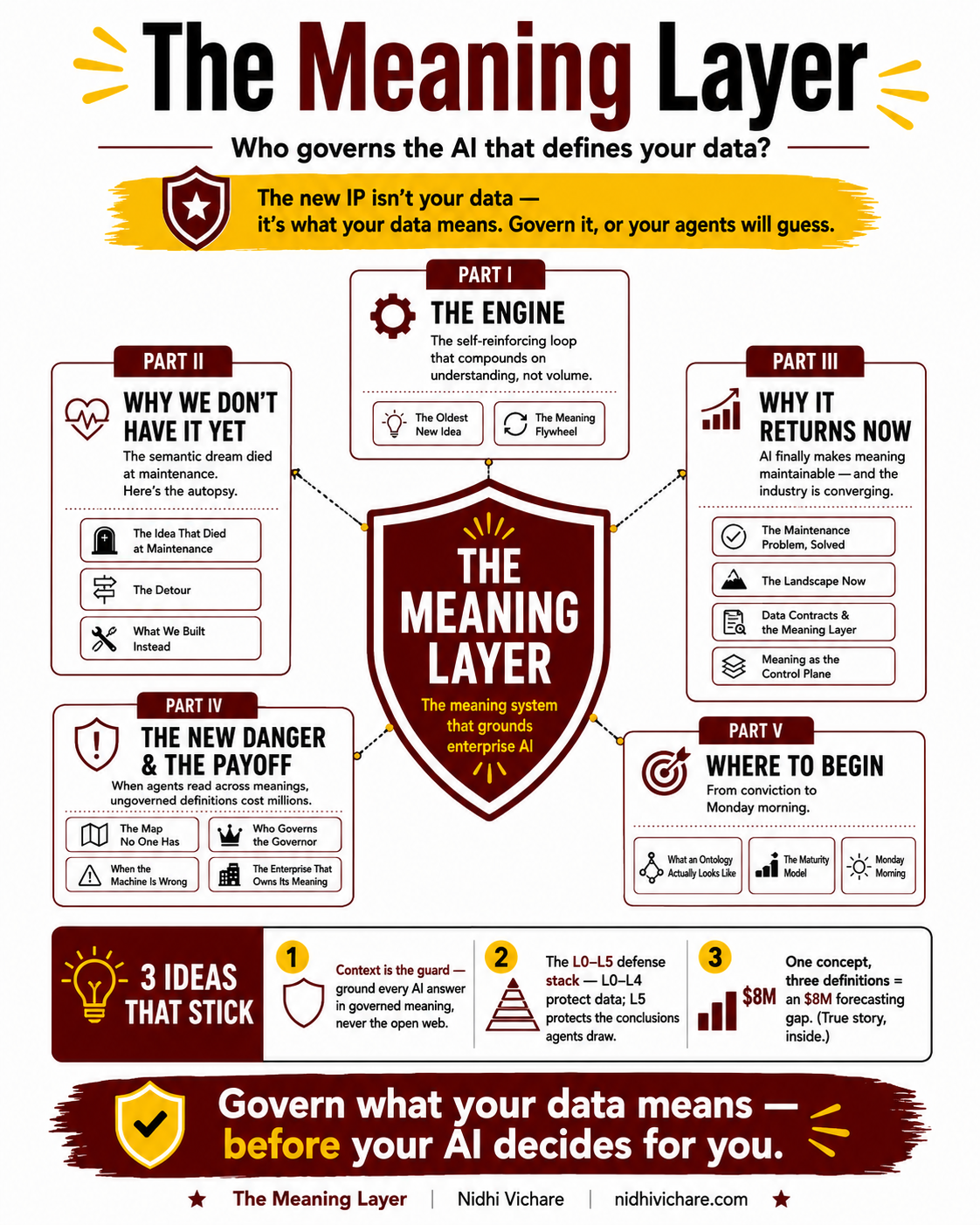
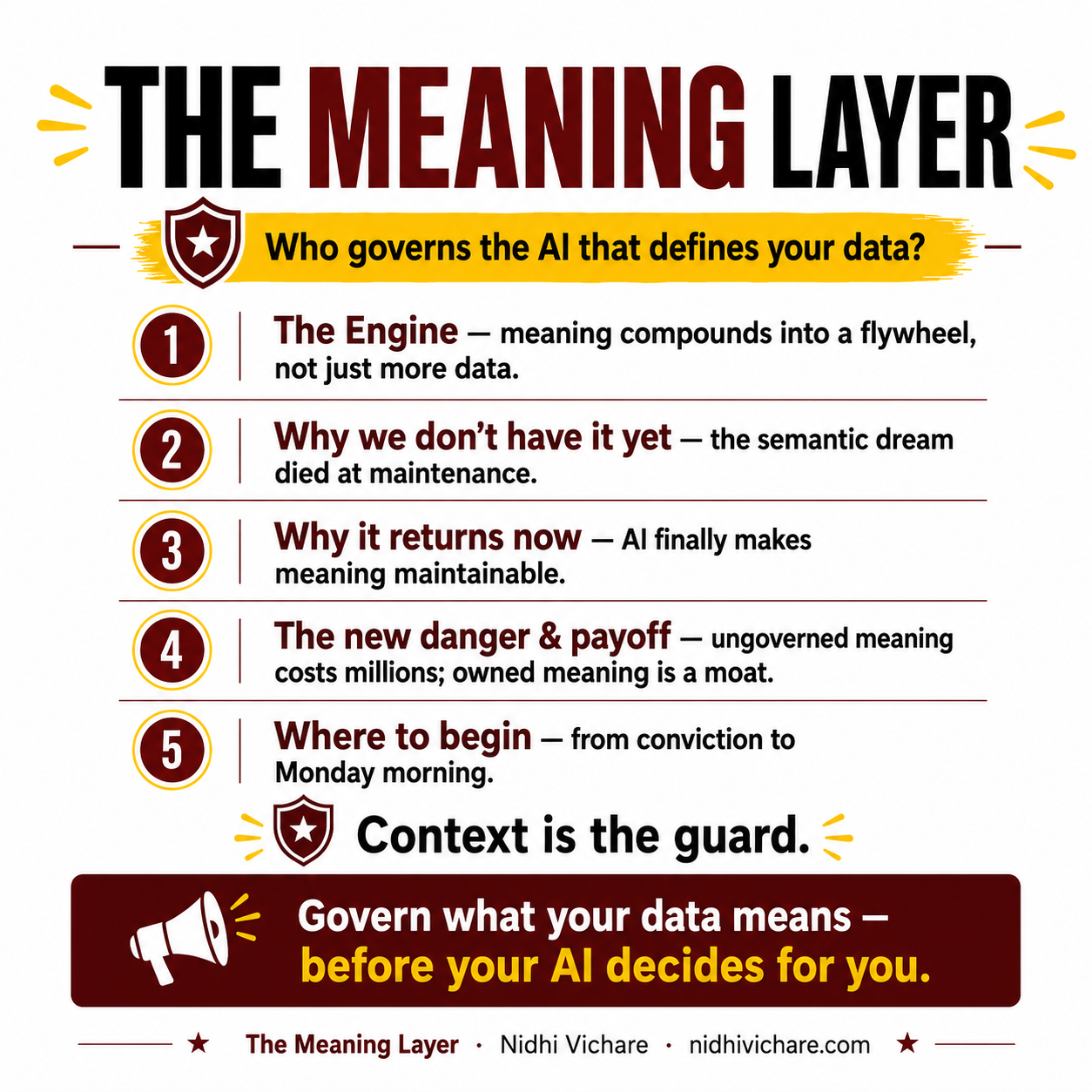
The book at a glance

The whole argument on one card. Save or share any of these. Click to open full size.

Nidhi Vichare, Chief Data and AI Officer and author of The Meaning Layer

Nidhi Vichare

Chief Data & AI Executive · Author

Nidhi Vichare helps organizations govern meaning at scale. She writes on enterprise AI strategy, data architecture, causal measurement, AI ROI, agentic systems, and modern leadership for senior data and AI leaders.

The Meaning Layer is her first book: the argument she has been making to boards and architecture teams, written down.

Companion repository · free & open source

Don’t just read it. Run it.

The Meaning Layer Starter Kit on GitHub: build your first governed enterprise ontology in an afternoon, with a context API agents can call, catalog sync, and the governance loop running as code.

$ git clone https://github.com/nvichare/meaning-layer-starter-kit
Ontology · Semantics · Context engineering

Key concepts, defined

The vocabulary behind the meaning layer, written plainly for readers and for the AI systems that index this page.

What is the meaning layer?

The meaning layer is the governed definition of what your data means: the ontology, semantics, metrics, and business context that sit above raw data and tell every system and every AI agent how to interpret it. It is the layer most enterprises leave ungoverned, so their agents guess.

What is harness engineering?

Harness engineering is the discipline of building the harness that steers an AI agent: the governed context, ontology, and guardrails wired around a model so it acts on approved meaning instead of improvising. The Meaning Layer treats the harness as the real control surface for enterprise AI.

What is an ontology in enterprise AI?

An ontology is a formal model of the entities, relationships, and definitions in your business: a shared vocabulary that turns scattered data into meaning that machines and agents can reason over. A governed ontology is the backbone of the meaning layer.

Why do semantics matter for AI?

Semantics are the meaning behind your data, what a term actually denotes in context. When semantics are ungoverned, two systems read the same word three ways and an agent optimizes the wrong thing. Governing semantics is how you keep AI decisions correct, consistent, and auditable.

What is context engineering?

Context engineering is the practice of assembling the right governed context, ontology, definitions, policies, and retrieved knowledge, then delivering it to a model at decision time. It is how the meaning layer reaches the agent, and a core skill the book teaches.

Who should read The Meaning Layer?

Chief data and AI officers, enterprise architects, data and AI leaders, and anyone responsible for agentic AI, data governance, or knowledge-graph and semantic strategy who needs AI to act on governed meaning rather than guesses.

Govern what your data means,
before your AI decides for you.

Your agents are already acting on meaning. Make it governed, versioned, and owned.

Available now on Amazon in Kindle and Paperback · Starter Kit free on GitHub.