What OpenClaw Gets Right, and What It Gets Dangerously Wrong
A CDO's perspective on AI agents, productivity hype, and the security trade-offs no one is talking about. Why installing OpenClaw is like handing a stranger root access to your machine.

When Productivity Meets Root Access
Author: Nidhi Vichare
Date: March 6, 2026
Read time: ~7 min
TL;DR
The appeal: OpenClaw automates email triage, scheduling, and research coordination. The open-source community is shipping fast, and the productivity gains are real.
The danger: You're granting root-level access to your entire machine: file system, SSH keys, cloud credentials, everything. No access controls, no audit trail, and no kill switch.
The deeper problem: Our entire auth stack was designed for humans who act slowly and deliberately. AI agents move at machine speed, and the moment you remove the human from the loop, the security model falls apart.
What to do: Experiment in sandboxes with throwaway credentials. Never connect real accounts. Treat any tool that asks for root access with the same skepticism you'd give a stranger asking for your laptop.
The Experiment
I'll admit it. I installed OpenClaw.
I've spent my career in data. I've built pipelines, governed datasets, stood up analytics platforms, and spent more hours than I'd like to count thinking about who has access to what and why. Security isn't a side interest for me. It's baked into everything I do. When you're responsible for an organization's data, you learn very quickly that the fastest way to lose trust is to lose control.
So when OpenClaw started making the rounds, I was genuinely curious. An open-source AI agent that could triage my inbox, manage my calendar, coordinate across tools? As someone who lives in the weeds of productivity and information flow, I wanted to see what it could actually do.
I grabbed an isolated Mac mini, set up a clean test environment with no real accounts, and ran the installer. And then I started digging into what it was actually asking for.
That's when the excitement turned into something closer to alarm.
The productivity is real. So is the risk.
Here's what OpenClaw gets right: the productivity is real. I've watched it automate tasks that used to eat hours of my week. Email triage, scheduling, research coordination. The open-source community behind it is shipping fast, and the demos are genuinely impressive. For anyone drowning in operational overhead, the appeal is obvious.
Credit where it's due: The open-source community behind OpenClaw is building something genuinely impressive. 247,000+ GitHub stars don't happen by accident. The productivity gains are real, and that's exactly what makes the security story so important to get right.
The problem isn't just OpenClaw. It's how we secure AI agents.
But here's what OpenClaw gets dangerously wrong. And this part matters.
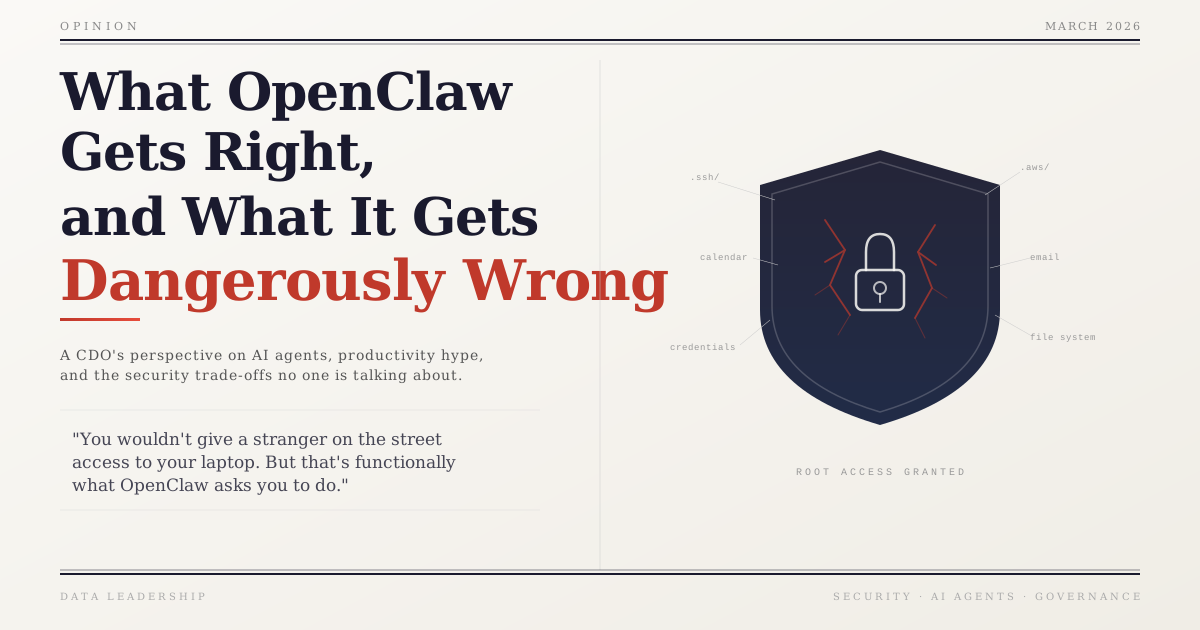
Most people don't realize what they're actually consenting to when they install it. You're not just adding a helpful assistant to your workflow. You're handing over root-level access to your entire machine. Your file system. Your credentials. Your SSH keys sitting in your .ssh directory. Your cloud configs tucked away in your .aws folder. Your graphics card. Everything.
And here's what really unsettled me: reports have surfaced that OpenClaw's install script doesn't always respect your choices. There are accounts of people declining the installation, only to discover later that it installed itself globally anyway. When a tool doesn't take "no" for an answer, that tells you everything you need to know about how much thought went into its security model.
OpenClaw also has no meaningful access controls, no audit trail, and no way to revoke permissions in real time. If you're a developer, you've essentially handed your most sensitive credentials to an LLM context. If something goes sideways, whether through prompt injection or simple context drift, there's no kill switch. No guardrail. No way to claw back what you've exposed.
The bottom line: It's essentially a self-inflicted rootkit. You wouldn't give a stranger on the street access to your laptop. But that's functionally what OpenClaw asks you to do.
The Structural Problem
The more I sat with it, the more I realized the danger is amplified by who OpenClaw is reaching. Until recently, most AI agent tools with this kind of capability lived in the domain of software engineers. People who, while not always security experts, at least understand how these systems work under the hood. OpenClaw changed that. It's been packaged and promoted as something anyone can use. And that means millions of people are granting machine-level access to their systems without understanding what that actually means.
But the problem goes deeper than OpenClaw. It's structural.
Every agentic workflow runs on the same premise: a human delegates authority to an automated process. In the data world, we understand delegation. We build role-based access. We scope permissions. We log everything. But AI agents break that model in a fundamental way.
When you authorize an agent to act on your behalf, that authorization captures your intent at a single moment in time. But the agent's behavior isn't static. It's dynamic, contextual, and sometimes unpredictable. Its context can be corrupted through prompt injection or simply drift as it processes new information. And we have no protocols that can reassess that intent at machine speed.
Our entire authentication and authorization stack was designed for humans. Humans who act slowly, make deliberate choices, and can be prompted to re-confirm when the stakes change. Agents don't operate that way. They move at machine speed, and the moment you take the human out of the loop to capture those productivity gains, the security model falls apart.
The governance gap: We've spent decades building systems to ensure that data access is intentional, auditable, and revocable. AI agents bypass all of that in a single install script.
Changing the System, Not the Blame
There's a line from Donella Meadows' Thinking in Systems that I keep returning to. You don't change behavior. You change the system that produces the behavior. The people building tools like OpenClaw aren't being reckless. They're responding to a system that rewards speed and productivity above all else. AI agents are the logical output of that system.
So the answer isn't to blame individual tools or developers. It's to build a better system of protocols: how agents authenticate as themselves, how their permissions evolve in real time, how we maintain governance at machine speed without re-inserting the human bottleneck these tools were designed to remove.
That's the problem I find myself thinking about constantly. And as someone who's spent a career at the intersection of data and trust, I believe it's one of the most important problems we need to solve.
If you're going to experiment, do it safely.
In the meantime, if you're going to experiment with OpenClaw or tools like it (and I think you should, because the learning matters), do it with guardrails:
- Run it on dedicated hardware or in a sandbox
- Don't connect it to your real accounts. Create throwaway credentials
- Isolate everything you can
- Approach the hype with skepticism. Just because something is open-source doesn't mean it's safe
Remember: Just because it promises productivity doesn't mean it's earned your trust. Transformation without governance isn't innovation. It's exposure.
The Road Ahead
We're in the early days of something transformative. But as a data leader, I know that transformation without governance isn't innovation. It's exposure. The productivity gains from AI agents are real. The risks are just as real. And the system that reconciles both? That's what we need to build next.
Further Reading and Sources
- OpenClaw GitHub Repository — The open-source project itself, with 247,000+ stars as of early March 2026.
- OpenClaw Official Site — Overview, install instructions, and documentation.
- OpenClaw Wikipedia Entry — Background on the project's origins, name changes, and rapid rise.
- From Magic to Malware (1Password) — How the top-downloaded OpenClaw skill turned out to be a malware delivery chain.
- What Security Teams Need to Know (CrowdStrike) — Enterprise-focused breakdown of deployment risks and detection strategies.
- Risks of Exposed AI Agents (Bitsight) — 30,000+ exposed instances in just twelve days.
- OpenClaw Found Unsafe for Use (Kaspersky) — 512 vulnerabilities identified, including eight critical.
- The OpenClaw Security Crisis (Conscia) — Deep dive into CVE-2026-25253 and architectural weaknesses.
- From Clawdbot to OpenClaw (CNBC) — The project's rise, adoption, and controversy.
Build with conviction. Govern with discipline.
Nidhi Vichare
About the author
Nidhi Vichare is an enterprise AI and data executive, platform architect, and author of The Meaning Layer. She writes about enterprise AI strategy, data architecture, causal measurement, AI ROI, agentic systems, and modern leadership for senior data and AI leaders.