Ten Weeks That Changed the Operating Rhythm
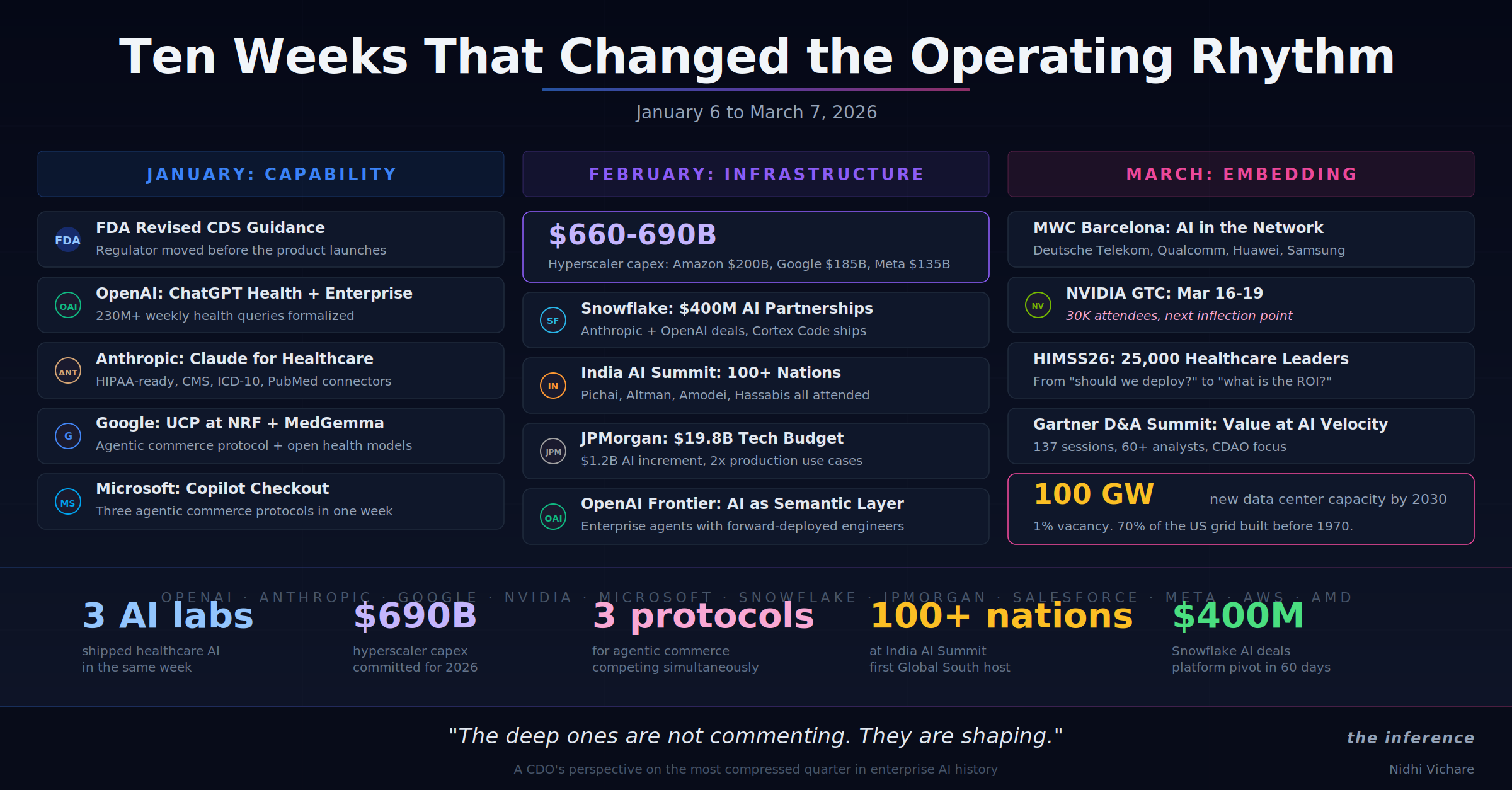
Between January 6 and March 7, 2026, the AI industry compressed two years of sequential development into ten weeks of simultaneous movement. Products shipped. Infrastructure commitments hit $660-690B. Regulators adapted. The data platform became the AI platform. A continuous story from the perspective of a CDO.

The AI industry compressed two years of sequential development into ten weeks of simultaneous movement.
Author: Nidhi Vichare
Date: March 7, 2026
Read time: ~10 min
TL;DR
Week 1: The FDA moved first. OpenAI and Anthropic launched healthcare AI products back to back. Google released open medical models. One week, three companies, both sides of the market.
Week 2: Google unveiled the Universal Commerce Protocol at NRF with Shopify, Target, Walmart. Three competing visions for how AI agents will buy things on behalf of consumers.
Weeks 3-6: Hyperscalers committed $660-690B in data center capex for 2026. India hosted the global AI summit. Sovereignty became a boardroom question.
Weeks 6-8: Snowflake executed $400M in AI partnerships. OpenAI launched Frontier. JPMorgan disclosed a $19.8B tech budget. The data platform became the AI platform.
Weeks 9-10: AI entered the network (Deutsche Telekom), the silicon (Qualcomm 3nm NPU), and the governance conversation (HIMSS26). The shift from "deploy" to "govern" is now operational.
Every CEO and executive I spend time with is actively learning about AI. The ones pulling ahead decided months ago that this was not a quarterly initiative. It was a daily practice.
Then January happened. And February. And the first week of March. And what became clear is that the daily practice is no longer optional for anyone.
Between January 6 and March 7, 2026, the AI industry compressed what should have been two years of sequential development into ten weeks of simultaneous movement. Products shipped. Infrastructure commitments reached numbers that have no historical precedent. Regulators adapted. Entire industries got new protocol layers. A Global South nation hosted the world's most powerful technology leaders. And the data platforms that most enterprises already run on quietly became AI platforms.
This is what happened, told as one continuous story, from the perspective of someone whose job it is to make sense of it for organizations that build on data.
Week 1: The Regulator Moved First
On January 6, while most of the technology world was at CES looking at gadgets, the FDA published revised guidance on Clinical Decision Support software. The change was specific but consequential: AI software that provides a single clinically appropriate recommendation to a physician can now operate under enforcement discretion rather than being regulated as a medical device. The prior guidance had insisted on multiple options to avoid device classification. The 2026 version acknowledged what practitioners already knew: sometimes one recommendation is the right one.
Commissioner Makary framed it as cutting unnecessary regulation to promote innovation. But for anyone building AI for healthcare, it was something more important. It was the regulatory apparatus moving before the product launches, not after them. That sequence matters.
Week 1, continued: Healthcare AI Becomes a Three-Front War
The next day, January 7, OpenAI launched ChatGPT Health. A sandboxed experience where consumers connect medical records and wellness apps. Over 230 million people were already asking ChatGPT health questions weekly. OpenAI simply formalized what was happening.
The day after that, OpenAI launched ChatGPT for Healthcare, the enterprise product: HIPAA-compliant, rolling out at Boston Children's Hospital, Cedars-Sinai, Stanford Medicine, Memorial Sloan Kettering. Consumer and enterprise, back to back.
Four days later, on January 11, Anthropic launched Claude for Healthcare at the J.P. Morgan Healthcare Conference. HIPAA-ready tools connecting to the CMS Coverage Database, ICD-10 codes, PubMed. Targeting prior authorization, claims appeals, care coordination.
Two days after that, Google released MedGemma 1.5 and MedASR. Open models. Free for research and commercial use. A 4-billion-parameter model handling 3D medical imaging natively. A speech-to-text model cutting transcription errors by more than half compared to general-purpose alternatives.
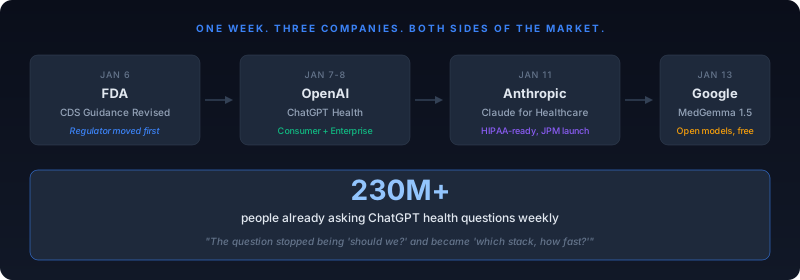
One week. Three companies. Both sides of the market. The regulator already out ahead. If you are a CDO in healthcare, the question stopped being "should we?" and became "which stack, how fast, and can our governance handle it?"
Week 2: Retail Gets Its Protocol Moment
On January 11, the same day Anthropic launched its healthcare product, Google CEO Sundar Pichai took the stage at the National Retail Federation conference in New York. Not a developer event. Not a cloud summit. A retail conference. He personally unveiled the Universal Commerce Protocol: an open standard for agentic commerce, co-developed with Shopify, Target, Walmart, Etsy, and Wayfair, endorsed by Visa, Mastercard, Stripe, and twenty others.
UCP standardizes how AI agents discover products, execute checkout, and manage post-purchase workflows. Microsoft launched Copilot Checkout with Shopify in the same window. OpenAI had already launched its own Agentic Commerce Protocol months earlier.
Three competing visions for how AI agents will buy things on behalf of consumers. Three protocol layers, all announced within weeks of each other.
For retail and CPG CDOs: Your product data quality is no longer a back-office concern. It is a revenue-critical asset. If your catalog metadata is inconsistent, your products will not appear when agents go shopping.
Weeks 3 through 6: The Physical Layer
If January was about products, February was about what sits underneath them.
The five largest U.S. cloud providers committed to spending between $660 billion and $690 billion on data center infrastructure in 2026. Nearly double 2025 levels. Amazon alone: $200 billion. Google: up to $185 billion. Meta: up to $135 billion.
These numbers need context. JLL reports that nearly 100 gigawatts of new data center capacity will come online by 2030, doubling global capacity. Vacancy rates are at 1%. Construction costs have risen to $11.3 million per megawatt for the shell alone, with AI fit-out adding another $25 million on top. Power, not demand, is the binding constraint. Seventy percent of the U.S. grid was built between the 1950s and 1970s.
NVIDIA invested $2 billion more in CoreWeave. AMD signed a $100 billion deal with Meta. SpaceX acquired xAI. Jensen Huang estimated $3 to $4 trillion in AI infrastructure spending by decade's end.
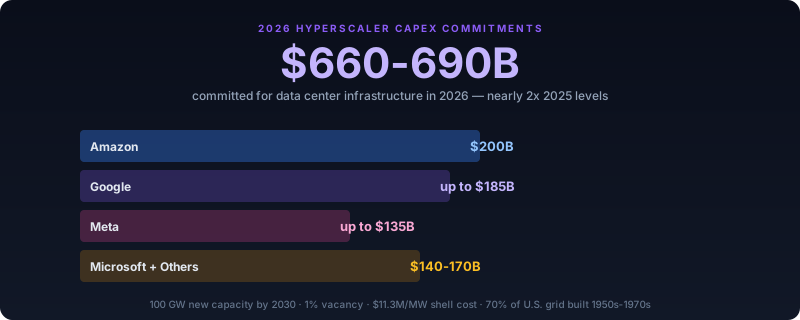
The layer most executives ignore: Compute availability, power constraints, and data center proximity now shape your AI deployment timeline, your cloud costs, and your vendor leverage. This is affecting everyone directly.
Week 6: India Enters the Room
On February 19, Prime Minister Modi inaugurated the India AI Impact Summit in New Delhi. The first time a Global South nation hosted the global AI summit series that began at Bletchley Park.
Over 100 country delegations. Twenty heads of state. Sixty ministers. And in the audience: Sundar Pichai, Sam Altman, Dario Amodei, Demis Hassabis, Mukesh Ambani. Everyone came.
India used the platform to showcase AI's impact on healthcare, agriculture, education, and energy. Adani announced $100 billion in data center infrastructure. Google committed $15 billion in Indian AI infrastructure. Blackstone led a $1.2 billion raise for an Indian AI cloud platform.
But the summit also revealed tensions. The IISS noted that India sidestepped the harder debates about agentic AI's impact on its own IT services sector. OpenAI's COO, speaking on the sidelines, was candid: enterprise AI has not yet truly penetrated business processes at scale.
The sovereignty question is now unavoidable: Where your AI is developed, where data is stored, which chips are used, who controls the infrastructure. Three quarters of leaders surveyed by the World Economic Forum said location of AI development is a key factor in their technology decisions. That was not a priority twelve months ago.
Weeks 6 through 8: The Platforms Mature
Three things happened in February that signal something bigger than individual product announcements.
First, OpenAI launched Frontier: a platform positioning AI as a semantic layer for the enterprise. Not a chatbot on top of workflows, but the connective tissue between data warehouses, CRM systems, and business applications. At one manufacturer, agents cut production optimization from six weeks to one day.
Second, Snowflake executed $400 million in AI partnerships: $200 million with Anthropic in December, $200 million with OpenAI in January. Both deals embed frontier AI models natively inside the Snowflake environment, so enterprises can run AI on their governed data without moving it elsewhere. Then in February, Snowflake launched Cortex Code, an AI coding agent that understands your data context and builds pipelines, analytics, and applications through natural language. Early adopters report five-to-ten times productivity gains.
Third, JPMorgan's February Investor Day laid out the hard numbers. Technology budget: $19.8 billion. AI increment: $1.2 billion. Production AI use cases: doubled in 2025. Jamie Dimon's framing: returns are hard to quantify, but the investment is necessary for competitive positioning.
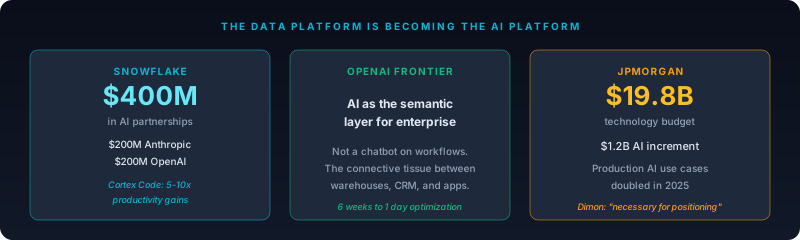
The pattern across all three: AI is no longer a tool you add to your stack. It is becoming the stack. The data platform is becoming the AI platform. The enterprise license is becoming the agentic license. The question for CDOs is no longer "do we have an AI strategy?" It is "does our data architecture support the AI operating model we need?"
Weeks 9 and 10: AI Enters the Network and the Silicon
MWC Barcelona opened March 2 under the theme "The IQ Era." AI was not a sideshow. It was the product.
Deutsche Telekom unveiled an AI call assistant that lives inside the telephone network. Not on a device. In the network itself. It works on any phone, including landlines. Activate it mid-call; it translates, summarizes, answers questions, and will eventually book your reservations while you are still talking.
Qualcomm launched the first 3nm wearable chip with a neural processing unit running 2-billion-parameter models on your wrist. Huawei introduced an AI data platform cutting inference latency by 90%. AWS committed $33 billion to Spain, positioning it as Amazon's European AI epicenter.
And the same week, HIMSS26 opened in Las Vegas. Twenty-five thousand healthcare leaders. Six hundred sessions. The shift from "how do we deploy AI?" to "how do we govern it, measure its ROI, and keep it secure?" HIMSS CEO Hal Wolf said it directly: the conversation has moved from theoretical to operational.
What the Ten Weeks Reveal
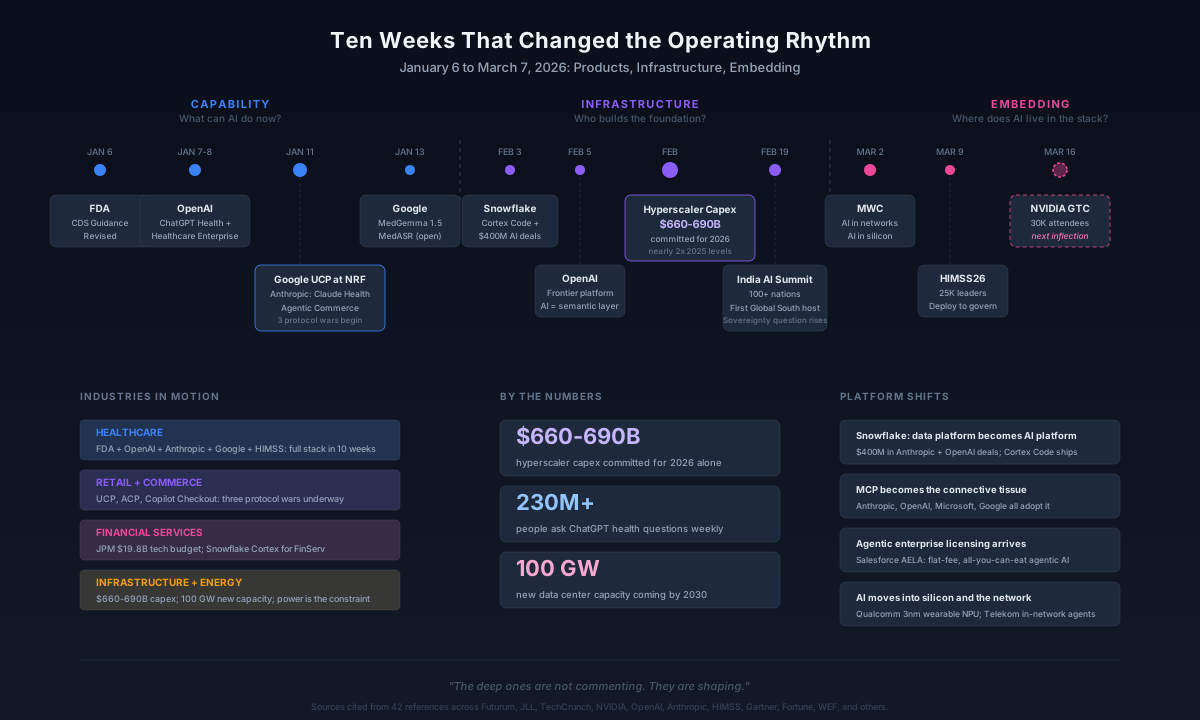
The progression is not random. It follows a maturation arc that maps to how serious organizations are actually working through AI adoption.
January was capability: what can these tools do? February was infrastructure: who builds the foundation, where, and under whose sovereignty? March is embedding: where does AI live in the stack, and what does that change about everything else?
The people who are ahead are not waiting for this arc to complete before they act. They are learning at the same cadence the technology is deploying. Reading daily. Building daily. Testing models. Writing code. Debating architecture. Several organizations I work with now mandate weekly AI education for their executive teams. Not optional. Not quarterly. Weekly.
The deep ones go across the stack: chips, energy, data centers, infrastructure, enterprise workflows, context graphs. They go broad: capital markets, regulatory posture, sovereignty, competitive landscapes. They go real: hard numbers, measurable productivity shifts, actual cost takeout. And they go social: people impacts, education, workforce development, the opportunities that open when organizations invest in AI fluency at every level.
There are ambiguities everywhere. The richest thinking comes from diverse inputs. Different industries. Different journeys. Different scales.
The deep ones are not commenting. They are shaping.
And the distance between their learning cadence and everyone else's is where competitive advantage is being created right now.
What's Coming Next
The ten weeks covered here set the table. The next sixty days will determine who acts on it. Several conferences will shape the next wave of decisions for data and AI leaders:
- HumanX (March 10-12, Las Vegas) — AI and human-centered design, responsible deployment, workforce transformation.
- NVIDIA GTC (March 17-21, San Jose) — Next-gen Blackwell Ultra GPUs, sovereign AI infrastructure, agentic frameworks at the chip level.
- Gartner Data & Analytics Summit (March 24-26, Orlando) — AI-augmented analytics, data fabric, governance frameworks for generative AI.
- Snowflake Summit (June 2-5, San Francisco) — Cortex AI in production, native LLM integration, agentic workflows on governed data.
The pattern: Every major conference in Q1-Q2 2026 has shifted its agenda from "what is AI?" to "how do we govern, measure, and operationalize it?" The capability question is settled. The execution question is where the work is now.
Frequently Asked Questions
What happened in AI between January and March 2026?
Between January 6 and March 7, 2026, the AI industry compressed two years of sequential development into ten weeks. January was capability: the FDA revised Clinical Decision Support guidance, OpenAI and Anthropic launched healthcare products, Google released open medical models, and Google unveiled the Universal Commerce Protocol at NRF. February was infrastructure: hyperscalers committed $660-690 billion in data center capex, India hosted the global AI summit, and Snowflake executed $400 million in AI partnerships. March was embedding: AI entered networks (Deutsche Telekom), silicon (Qualcomm 3nm NPU), and governance conversations (HIMSS26).
What is the Universal Commerce Protocol?
Universal Commerce Protocol is an open standard for agentic commerce unveiled by Google CEO Sundar Pichai at the National Retail Federation conference on January 11, 2026. It was co-developed with Shopify, Target, Walmart, Etsy, and Wayfair, and endorsed by Visa, Mastercard, Stripe, and twenty others. UCP standardizes how AI agents discover products, execute checkout, and manage post-purchase workflows. Microsoft launched Copilot Checkout with Shopify in the same window, and OpenAI had already launched its own Agentic Commerce Protocol, creating three competing protocol visions.
How much are hyperscalers investing in AI data center infrastructure in 2026?
The five largest US cloud providers committed between $660 billion and $690 billion on data center infrastructure in 2026, nearly double 2025 levels. Amazon alone committed $200 billion, Google up to $185 billion, and Meta up to $135 billion. JLL reports nearly 100 gigawatts of new data center capacity coming online by 2030. Vacancy rates are at 1 percent. Construction costs have risen to $11.3 million per megawatt for the shell alone, with AI fit-out adding another $25 million. Jensen Huang of NVIDIA estimated $3 to $4 trillion in AI infrastructure spending by decade's end.
What did Snowflake announce in AI partnerships in early 2026?
Snowflake executed $400 million in AI partnerships: $200 million with Anthropic in December 2025 and $200 million with OpenAI in January 2026. Both deals embed frontier AI models natively inside Snowflake so enterprises can run AI on their governed data without moving it. In February, Snowflake launched Cortex Code, an AI coding agent that understands data context and builds pipelines, analytics, and applications through natural language. Early adopters reported five-to-ten times productivity gains. The data platform is becoming the AI platform.
Why did India's hosting of the AI Impact Summit matter?
On February 19, 2026, Prime Minister Modi inaugurated the India AI Impact Summit in New Delhi. It was the first time a Global South nation hosted the global AI summit series that began at Bletchley Park. Over 100 country delegations, 20 heads of state, and 60 ministers attended. Sundar Pichai, Sam Altman, Dario Amodei, Demis Hassabis, and Mukesh Ambani were in the audience. Adani announced $100 billion in data center infrastructure and Google committed $15 billion in Indian AI infrastructure. The summit made AI sovereignty, where AI is developed, where data is stored, and who controls the infrastructure, an unavoidable boardroom question.
Sources and References
- FDA Revised Clinical Decision Support Guidance (January 6, 2026)
- OpenAI: Introducing ChatGPT Health (January 7, 2026)
- Anthropic: Claude for Healthcare (January 11, 2026)
- Google: MedGemma 1.5 and MedASR (January 13, 2026)
- Google: Universal Commerce Protocol at NRF (January 11, 2026)
- JLL: Global Data Center Outlook 2026 (February 2026)
- India AI Impact Summit, New Delhi (February 19, 2026)
- OpenAI: Frontier Platform (February 2026)
- Snowflake: Cortex Code Launch (February 2026)
- JPMorgan Investor Day: Technology Budget Disclosure (February 2026)
- HIMSS26 Conference Coverage (March 2026)
- MWC Barcelona: The IQ Era (March 2-6, 2026)
- Deutsche Telekom: AI Call Assistant (March 2026)
- World Economic Forum: AI Sovereignty Survey (2026)
- NVIDIA: $3-4T Infrastructure Estimate (Jensen Huang, GTC preview remarks)
Keep building. We'll keep tracking.
The Inference
About the author
Nidhi Vichare is an enterprise AI and data executive, platform architect, and author of The Meaning Layer. She writes about enterprise AI strategy, data architecture, causal measurement, AI ROI, agentic systems, and modern leadership for senior data and AI leaders.