Executive Presence: Gravity, Not Volume
Executive presence is not charisma or volume. It is the quiet authority that makes a room recalibrate. Three behaviors, six verbal habits to remove, and a practical framework for senior leaders.

TL;DR. Presence Is Not Performance.
The strongest executives in the room interrupt the least. When they speak, everything else recalibrates.
Executive presence is gravity, not volume. Junior professionals rush to be liked. Senior leaders are comfortable being respected. The practical difference shows up in three behaviors: not chasing arguments, not over-contextualizing, and separating identity from feedback. This is Part 1 of the Modern Leadership series.
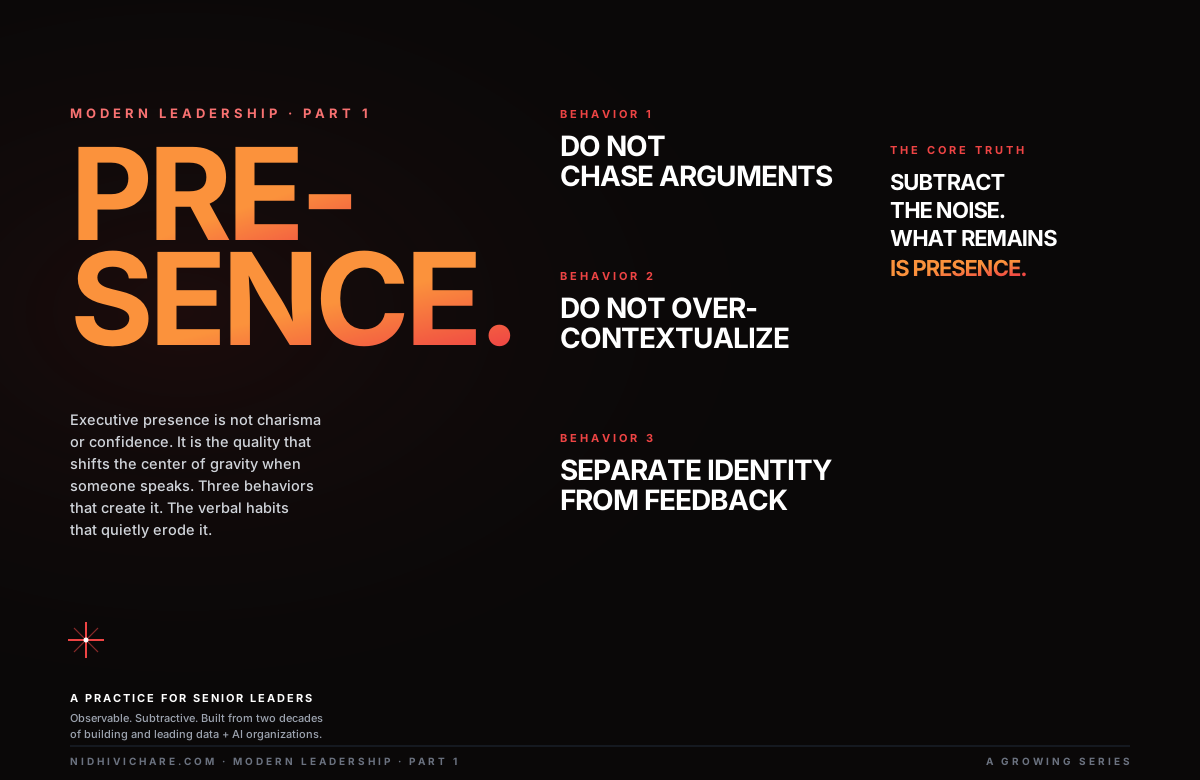
Most people misunderstand executive presence as charisma, confidence, or polish. It is none of those.
Executive presence is the quality that shifts the center of gravity in a room when someone speaks. The strongest executives do not talk the most. They interrupt the least. They choose moments strategically. When they do speak, everything else in the room recalibrates around their input.
What follows is the operating framework. Three behaviors that produce presence, one corporate truth that sits underneath them, and a short catalog of the verbal habits that quietly erode it.
Three Behaviors That Create Presence
1. Do Not Chase Arguments
Insecure people push to win. Senior leaders state a position and let silence stretch.
The verbal habits that quietly undo this are everywhere. "Just my two cents." "I could be wrong, but." "This is probably a dumb question." Every one of those phrases is a softener, and softeners signal a request for permission before the position has even landed.
The discipline is simple. Say what you think, then stop talking. The pause after a clean statement is not awkward. It is the mechanism by which the room decides whether to engage, agree, or push back. A leader who fills that pause with defensive qualifiers has taught the room that the position was negotiable before anyone asked.
2. Do Not Over-Contextualize
If it takes two minutes to land the point, the signal is that permission is being requested.
The structure that works is conclusion first. Risk first. Recommendation first. Defend the position only if challenged, but always open with clarity. Building up to a point through background, caveats, and qualifying context is a habit trained by college seminars and dissertation committees. It does not survive translation to the executive room.
The executive room compensates speakers for certainty per minute. Background before position inverts that ratio.
3. Separate Identity From Feedback
Arrogance reacts. Presence absorbs.
When challenged, the instinct for most people is to defend. The more senior the leader, the more often the response is a question in the opposite direction. "What assumption are we operating under?" The challenge gets redirected into inquiry. The leader stays in control of the tempo without raising their voice.
This is the behavior that separates the people who grow after hitting middle management from the ones who plateau. Middle managers treat disagreement as a threat to identity. Senior leaders treat it as data. Part 2 of this series goes deeper into what separates senior leaders who keep growing from those who plateau.
The Corporate Truth
Executive presence is, at bottom, tolerance for temporary discomfort.
Junior professionals rush to be liked. Senior leaders are comfortable being respected. The path from one to the other is not louder. It is steadier, clearer, and less apologetic.
The practical implication is that almost every upgrade a leader makes in this area is subtractive rather than additive. The work is removing the softeners, removing the over-context, removing the reactive defense. What is left underneath, when those habits are gone, is presence.
You will not argue, explain, or emote your way into executive presence. You will arrive at it by subtracting the things that are in its way.
The Verbal Habits Worth Auditing
A short catalog. Every phrase below is one I have caught myself using and worked to remove.
| Habit | Why It Erodes Presence | Replace With |
|---|---|---|
| "Just my two cents" | Signals the position is negotiable before it has landed | State the position, then stop |
| "I could be wrong, but" | Pre-emptively surrenders credibility | Either commit to the position or do not raise it |
| "I just wanted to check" | Reframes a decision as a request for permission | "The decision I need is..." |
| "Does that make sense?" | Outsources your clarity to the listener | "I will pause there" |
| Qualifier before the point | Trains the room to discount your input | Conclusion first, context only if asked |
| Over-apologizing for time | Communicates that your contribution is an imposition | Assume the room is here on purpose |
Each of these is small. Collectively, they are the difference between being respected and being managed around.
What to Do This Week
One audit. Not three, not five. One.
Pick the next meeting where you are not the decision-maker. Before you speak, name which of the three behaviors you are working on. After the meeting, write down exactly what you said and what you wanted to say. The gap between those two sentences is almost always where the work is.
Do that for four weeks. That is the full practice. Everything else in the executive presence literature is decoration on top of it.
Next in the series: What Separates Senior Leaders Who Keep Growing From Those Who Plateau
Next: what separates senior leaders who keep growing from those who plateau. If Part 1 is about subtraction, Part 2 is the complement — the seven rules you build on top of presence.
About the author
Nidhi Vichare is an enterprise AI and data executive, platform architect, and author of The Meaning Layer. She writes about enterprise AI strategy, data architecture, causal measurement, AI ROI, agentic systems, and modern leadership for senior data and AI leaders.