What Separates Senior Leaders Who Keep Growing From Those Who Plateau
Research from Tasha Eurich, Sylvia Ann Hewlett, and Herminia Ibarra on why some senior leaders keep growing while others plateau: self-awareness, sponsorship, outsight, and leadership identity.

Also known as: Quiet Excellence Will Not Get You Promoted. Here's What Will.
TL;DR. What Separates Leaders Who Keep Growing.
Senior leaders usually do not plateau because they suddenly become less capable. They plateau because the role changes and their operating model does not.
Research from Tasha Eurich, Sylvia Ann Hewlett, and Herminia Ibarra points to the same pattern from different angles: the leaders who keep growing build real self-awareness, make their value visible in the rooms that matter, earn sponsorship instead of relying on merit alone, and expand beyond the identity that made them successful earlier in their careers. The ones who do not are often still running the same excellent play from ten years ago, wondering why it stopped compounding. Part 2 of the Modern Leadership series.
Tasha Eurich's work shows that leaders keep growing when they build real self-awareness, especially external self-awareness: understanding how other people actually experience them.
Sylvia Ann Hewlett's work shows that leaders keep growing when strong performance becomes visible, sponsor-backed, and credible at the right level. Merit matters, but merit alone does not move careers at senior altitude.
Herminia Ibarra's work shows that leaders keep growing when they stop leading only from their current role and start expanding into a broader identity, stronger networks, and a clearer point of view about where value is going.
Taken together, the message is simple: senior leaders plateau when they over-rely on execution, private competence, and past identity. They keep growing when they combine self-awareness, visibility, sponsorship, and outsight.
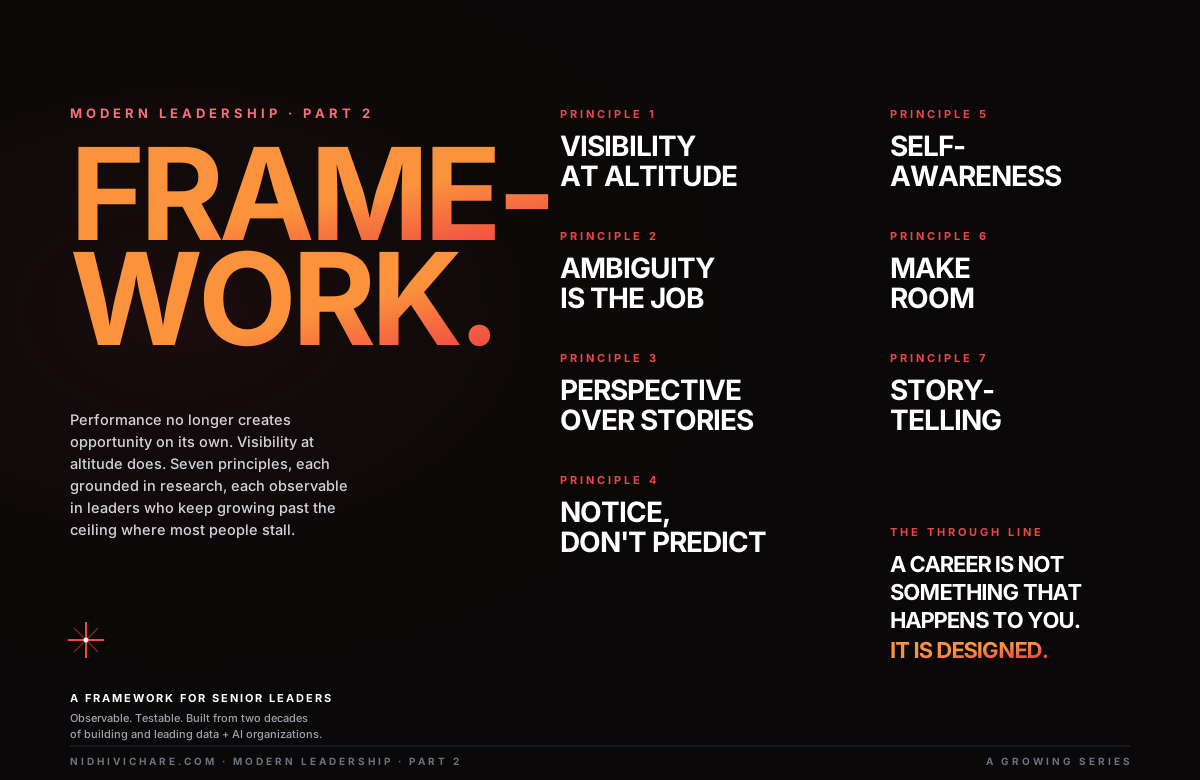
The Framework at a Glance
Tap any card to flip it and read the trap, the discipline, and the research behind it.
The assumption that good work speaks for itself is the single most expensive idea in a senior leader's career. It does not speak. It never has.
Over two decades of building platforms and leading data and AI organizations, I have watched brilliant people stall at the same ceiling. Not because the work was bad. Because the rules for what actually gets people promoted, what keeps them relevant as industries turn over, and what makes them the person the room listens to have changed, and the rules are rarely discussed openly.
What follows are seven of those rules. Each grounded in research I have returned to repeatedly. Each observable in the leaders who keep growing past the ceiling where most people stall.
1. Performance Does Not Create Opportunity. Visibility at the Right Altitude Does.
Quiet excellence earns respect. It rarely earns advancement.
Sylvia Ann Hewlett's multi-year research at Coqual (formerly the Center for Talent Innovation) established the sponsorship gap: mentors advise, but sponsors spend their political capital to advocate for you in rooms you are not in. In her data, having a sponsor is associated with a meaningful lift in the odds of promotion, career satisfaction, and compensation growth across demographics. The people who advance are not necessarily the best performers in the building. They are the best performers whose work has reached the right people, often because someone whose name carries weight has narrated it for them.
This is not a case for self-promotion. It is a case for something more deliberate.
It means narrating outcomes instead of activities. It means attaching your name to the work that matters, and offering to present the summary to leadership rather than just producing the analysis and handing it off. A senior architect I worked with built a shared infrastructure layer that reduced cloud spend by roughly eight figures a year. Nobody above the director line knew she had built it. A peer presented the summary deck to the CFO. She left the company eighteen months later without a promotion. The work was excellent. The signal never reached the altitude where excellence translates into opportunity.
The most effective leaders I know are not the loudest in the room. They are the most intentional about where their signal lands.
The people above you are not ignoring your work out of malice. They are optimizing for their own bandwidth. If your work does not cross their desk with your name on it, you are invisible to the promotion conversation.
What Sylvia Ann Hewlett says: Performance alone does not move senior leaders upward. Sponsorship and executive visibility do.
2. Ambiguity Is the Job.
Early in a career, the work is defined for you. Later, figuring out what the work actually is becomes the work.
Executive transitions research, including McKinsey's long-running work on senior leadership onboarding, is consistent on one finding: leaders who stall at the top are almost always the ones who kept waiting for clarity before they committed. High-stakes decisions with incomplete information stop being the exception and start being the entire thing. What makes someone good at this is not intelligence, and it is not even experience. It is the ability to do four things in sequence: assess risk, move with speed when speed matters, move with precision when precision matters, and take full ownership of the outcome.
Especially when the outcome does not land the way you hoped.
A Chief Data Officer I know ran a high-visibility generative AI initiative that underdelivered against the target. The models worked. The data was clean. Business adoption did not materialize on schedule. When the board asked why, she did not blame the product team, the data team, or the vendor. She said: "We got the engineering right and the change management wrong. I should have put half the budget into adoption before we shipped, not after. That is on me." Six months later she had the largest operating-budget increase of anyone at her level. The board did not reward her because the project worked. They rewarded her because she processed the ambiguity in real time, took ownership, and emerged with a sharper operating thesis than the one she started with.
Leaders who need certainty before they commit do not scale. Leaders who can process complexity in real time do.
3. Prepare Perspective, Not Stories.
I have watched leaders walk into board reviews and strategy offsites having rehearsed every anecdote down to the phrasing. I have also watched leaders who had clearly thought hard about the world and could engage any question from that thinking. The difference is unmistakable.
Stories comfort the teller. Perspective serves the listener.
When you hold a real point of view on your industry, on where value is shifting, and on what good looks like in your domain, you stop needing to remember the right answer. You think out loud, and the thinking itself is the answer. Herminia Ibarra, the INSEAD scholar and author of Act Like a Leader, Think Like a Leader, calls this "outsight": the external perspective that comes from engaging with ideas and networks outside your immediate function. Insight alone is not enough at senior levels. The leaders who stay sharp are the ones continuously refreshing their view of the world, not the ones polishing a highlight reel of past wins.
Practical translation. Before your next board review, strategy offsite, or cross-functional forum, do not rehearse the three best anecdotes from your career. Write down, in bullet form, the four or five things you actually believe about where data and AI value are going inside your business. Those bullets are what the room is actually listening for. The anecdotes are just the evidence that you have earned the right to hold them.
What Herminia Ibarra says: Senior leaders keep growing when they develop outsight, broader networks, and a point of view beyond their function.
4. Future-Proofing Is Not Predicting. It Is Noticing.
People ask me how to future-proof a career. I do not think you really can, because the roles move too fast.
What you can do is notice when value is shifting before the role forces you to.
The World Economic Forum's Future of Jobs research has been steady on one finding across multiple editions: the half-life of technical skills has been compressing for a decade, and the disruption is not evenly distributed. Some functions will be substantially automated within the horizon of a five-year career plan. Others will not. The strongest technologists I have worked alongside were not the ones with the most current skills. They were the ones who sensed the next thing early and positioned themselves toward it before it was obvious to anyone else.
A principal engineer on my team in 2022 was working on a fairly traditional data-pipeline portfolio. By early 2023 she had quietly started shipping retrieval-augmented generation prototypes on the side. By mid-2024 she was the organization's senior-most voice on agentic architectures. She did not predict the LLM wave. She noticed the early signal and repositioned before she had to. The people around her who waited until "AI engineer" was a posted job title were competing against a crowded market with no head start.
If the work you are doing today will be automated tomorrow, the time to move is not when the automation arrives. It is now, while you still have the leverage to choose where you go next.
The career cost of moving six months early is almost always smaller than the cost of moving six months late. Early movers pick their next role. Late movers are assigned one.
5. Self-Awareness Is Not Optional.
The hardest question any senior leader gets, whether from a peer, a coach, or an honest direct report, is some version of: what is the most difficult part about working with you?
The people who answer "nothing" or offer a disguised strength ("I care too much," "I work too hard") are telling you everything in that non-answer.
Tasha Eurich's research, summarized in her Harvard Business Review piece "What Self-Awareness Really Is (and How to Cultivate It)" and the book Insight, is worth internalizing. Roughly 95 percent of people believe they are self-aware. The actual number, measured against colleagues' assessments, sits closer to 10 to 15 percent. The gap is not small, and at senior levels it is one of the most reliable predictors of whether someone continues to grow or quietly plateaus.
Leaders who cannot self-correct do not scale. The feedback loop starts with being honest about what you are actually like to work with, and what you have genuinely adjusted over time. One of the most effective VPs of data I have worked with answers that question this way: "I run hot in rooms where I think we are about to make a reversible mistake. I have had to learn that the room cannot always tell the difference between conviction and intimidation. My direct reports have a standing veto on my tone in meetings for that reason." That is why her peers trust her with the most sensitive calls and why her team does not flinch when she pushes back. Not because she is flawless, but because she has a working feedback loop the organization can see.
That honesty is rarer than it should be, and it is almost always what separates the leaders who keep growing from the ones who plateau.
What Tasha Eurich says: Leaders who keep growing have a visible feedback loop and understand how others actually experience them.
6. Making Room Is Leadership Too.
Somewhere along the way, we conflated leadership with seat-holding: the title, the reporting line, the operational control.
A healthy system requires movement. If you have been in the same seat for a long time and have not built a real successor, you have not been leading. You have been occupying.
Research on CEO succession from Harvard Business Review and the Stanford Graduate School of Business is consistent on one point: organizations that plan transitions with a named successor well ahead of the handoff outperform organizations that do not, across financial and cultural metrics. The logic cascades down. The most influential senior leaders I have watched move toward portfolio work when the timing is right. They advise. They mentor. They sit on boards. They expand their influence across many contexts instead of concentrating it in one.
They do not disappear. They make room.
A data-platform VP I respect built a strong number two over three years, then stepped into a fractional advisory role across four companies. Her former organization promoted the number two and did not skip a beat. Her new portfolio placed her in rooms she would never have reached by staying. Both outcomes compound. That is what legacy leadership actually looks like.
7. Storytelling Is the Premium Skill.
Technical depth matters. Business acumen matters. But the ability to translate complexity into a narrative that a non-expert can act on is what the market rewards now.
Paul Zak's neuroscience research, originally published in outlets including Harvard Business Review, has shown that narrative structure triggers oxytocin release, which materially increases trust, empathy, and recall. Jennifer Aaker at the Stanford Graduate School of Business has documented that stories are roughly 22 times more memorable than facts presented in isolation. This is not a marketing cliche. It is how the human decision-making system actually works.
Data without story does not move decisions. Strategy without narrative does not get funded.
A common failure mode in data and AI organizations is a team that produces extraordinary analysis and cannot move the business. The deck has nine charts. The recommendation is on slide eleven. By the time the executive reaches it, the window has closed. The teams that move the business open with the recommendation, anchor it in one memorable number, and use at most two charts to defend it. The analysis is not thinner. The narrative is sharper.
Whatever your discipline, the people who can articulate what the work means to someone who has not done the work are the people who end up in the room where the decisions actually get made.
Subtraction and Addition
Part 1 of this series argued that executive presence is subtractive. Remove the softeners. Remove the over-contextualization. Remove the reactive defense. What is left underneath, once those habits are gone, is presence.
These seven rules are the complement. They are what you build on top of presence, once presence is stable. Position yourself where value is moving. Narrate your work to the altitude where it gets translated into opportunity. Hold a defensible point of view. Confront your own blind spots. Make room for others. Tell the story that lets your work travel.
Subtraction is how you earn the right to be heard. Addition is how you turn being heard into growing.
None of this requires being louder, more political, or less yourself. It requires being more intentional about the signal you are sending, and more honest about whether that signal matches the leader you actually are.
The leaders I respect most do both.
What to Do This Month
Pick one principle. Not seven.
Score yourself honestly against it on a scale of one to ten. Then ask two people who have seen your work at close range to score you on the same scale. Do not explain the scoring in advance. Do not argue with their numbers when they come back. The gap between your score and theirs is the work.
Repeat quarterly. Rotate through the seven across a year.
Most leadership frameworks fail in practice because they are designed to be read once. The ones that compound are the ones turned into a recurring measurement. These seven are no different.
Part 3 of the Modern Leadership series is forthcoming.
New parts are added when the thinking gets sharp enough to commit.
Frequently Asked Questions
What causes senior leaders to plateau?
Senior leaders plateau when they keep optimizing for excellent execution inside the current role, but do not adapt to what the next level actually requires. At senior altitude, growth depends less on output alone and more on visibility, sponsorship, judgment, self-awareness, and the ability to operate from a broader leadership identity.
Is performance enough for senior-level growth?
No. Performance is necessary, but it is rarely sufficient. At senior levels, work has to be visible to the right people, translated into business relevance, and reinforced by trust, credibility, and sponsorship.
What does Tasha Eurich say about self-awareness in leadership?
Tasha Eurich's research suggests that self-awareness is much rarer than leaders think. The leaders who keep growing are usually the ones who understand both themselves and how others actually experience them. That external self-awareness is one of the clearest separators between growth and plateau.
What does Sylvia Ann Hewlett say about sponsorship?
Sylvia Ann Hewlett's work shows that mentors advise, but sponsors advocate. Senior leaders keep growing when someone with organizational weight is willing to narrate their value in rooms they are not in. Leaders plateau when they assume strong work will automatically speak for itself.
What does Herminia Ibarra say about leadership growth?
Herminia Ibarra argues that senior leaders grow through "outsight": expanding perspective through new experiences, broader networks, and a larger operating identity. Leaders plateau when they keep leading from the old role instead of evolving into the next one.
Sources and Further Reading
- Sylvia Ann Hewlett, Forget a Mentor, Find a Sponsor (Harvard Business Review Press). Coqual (formerly Center for Talent Innovation) research on sponsorship.
- Herminia Ibarra, Act Like a Leader, Think Like a Leader (Harvard Business Review Press). On the concept of "outsight."
- Tasha Eurich, "What Self-Awareness Really Is (and How to Cultivate It)," Harvard Business Review, January 2018. Book-length treatment: Insight.
- World Economic Forum, Future of Jobs Report, multiple editions. Ongoing research on skill disruption and half-life.
- Paul J. Zak, "Why Your Brain Loves Good Storytelling," Harvard Business Review, October 2014.
- Jennifer Aaker, Stanford Graduate School of Business, research and teaching on narrative and memorability.
- McKinsey & Company, executive transitions and senior leadership research.
- Harvard Business Review and Stanford Graduate School of Business longitudinal research on CEO succession.
About the author
Nidhi Vichare is an enterprise AI and data executive, platform architect, and author of The Meaning Layer. She writes about enterprise AI strategy, data architecture, causal measurement, AI ROI, agentic systems, and modern leadership for senior data and AI leaders.